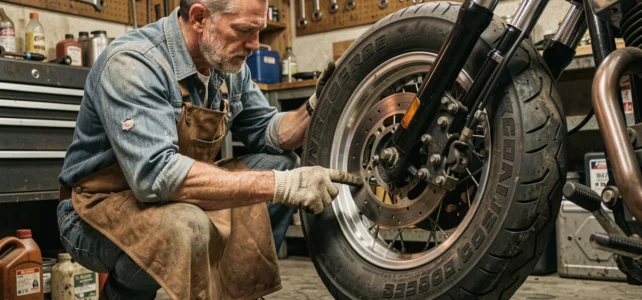
On a custom motorcycle, the rear tire often measures more than 150 mm in width, sometimes much more. This unusual width, combined with a specific rounded profile, radically changes the handling in corners and straight lines compared to a sportbike or a roadster. Choosing tires for a custom motorcycle therefore requires understanding some specific characteristics of this type of machine.
Technical inspection for motorcycles and custom tires: what has changed in 2024
Since April 15, 2024, technical inspections are mandatory for all motorized two-wheelers in France, including customs. Tires are among the explicitly checked points: general condition, dimensions, load and speed indices, as well as rubber aging.
Do you ride your custom little, perhaps a few thousand kilometers a year? The tread may seem intact while the rubber has hardened deeply. A tire should be replaced every five to seven years, even if it appears visually correct. Rubber loses its grip properties over time, and this aging is now a reason for a re-inspection.
“Exotic” tire sizes, common on customized customs (imported whitewalls, non-homologated dimensions), pose a real risk of immobilization during inspection. Before directing the choice of custom motorcycle tires towards a model with an attractive look, check that its dimensions and indices are listed in your machine’s manufacturer manual.
Load and speed indices on custom motorcycle tires: read the sidewall before buying
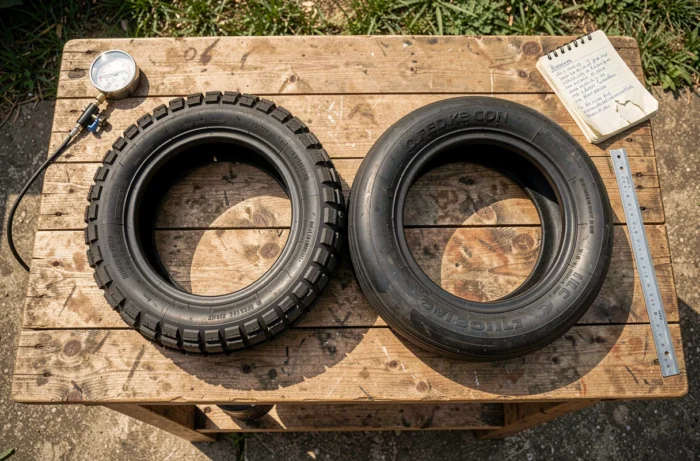
Have you ever noticed the molded inscriptions on the side of your tires? For example, “150/80 B16 77H”. Each element has a specific role, and on a custom, two of them deserve special attention.
Load index, a legal minimum
The number “77” in our example corresponds to the maximum load that the tire can support. On a loaded Harley-Davidson or Japanese cruiser (saddlebag, passenger), the total weight can increase quickly. Fitting a tire with a load index lower than the manufacturer’s recommendation is prohibited. Beyond the legal aspect, an undersized tire in load deforms excessively, heats poorly, and loses stability.
Speed index, often overlooked
The letter “H” indicates the maximum speed supported by the tire. On a custom limited to cruising speed, one might think this parameter is of little importance. In reality, a speed index that is too low can invalidate your insurance in the event of a claim, even if you were riding below the limit.
Only the dimensions and indices listed by the manufacturer are compliant. A different fitting, even “improved” in width for style, exposes you to a denial of compensation and a re-inspection during the technical control.
Tire profile and road behavior of a custom
The profile of a tire is the curvature of its tread viewed in cross-section. On a sportbike, the profile is very rounded to facilitate leaning into corners. On a custom, it’s the opposite: the profile is flatter to stabilize the motorcycle in a straight line.
This design choice has a direct consequence. In a curve, the motorcycle requires more effort on the handlebars to enter the turn. A sport-touring tire mounted on a custom will give an unusual feeling of nervousness, even instability at low speeds. The specific custom tire compensates with superior comfort on long trips and more even wear in the center of the tread.
The type of casing also plays a role. Most customs use diagonal casing tires (marked “B” or “-” in the size), which are better suited to the chassis and suspensions of these motorcycles. Radial tires, common on sportbikes, generally do not suit customs unless explicitly mentioned by the manufacturer.
Grip in the rain and rubber: adapting the tire to its actual use
Many custom owners ride exclusively in good weather. If this is your case, a longevity-oriented tire with harder rubber may be suitable. However, if you use your machine daily, including on rainy days, wet road behavior becomes a major selection criterion.
Here are the concrete elements to evaluate before purchase:
- Tread pattern: deep and well-distributed grooves evacuate water more effectively. A tire with a minimalist tread pattern (like a “visual slick”) loses grip as soon as the road is wet.
- Rubber hardness: a soft rubber grips better on wet surfaces but wears out faster. On a heavy custom, wear is already accelerated by the weight, so finding the right compromise is essential.
- Width of the rear tire: a very wide tire (over 200 mm) tends to “float” more on puddles. The larger the contact area, the greater the risk of aquaplaning at moderate speeds.
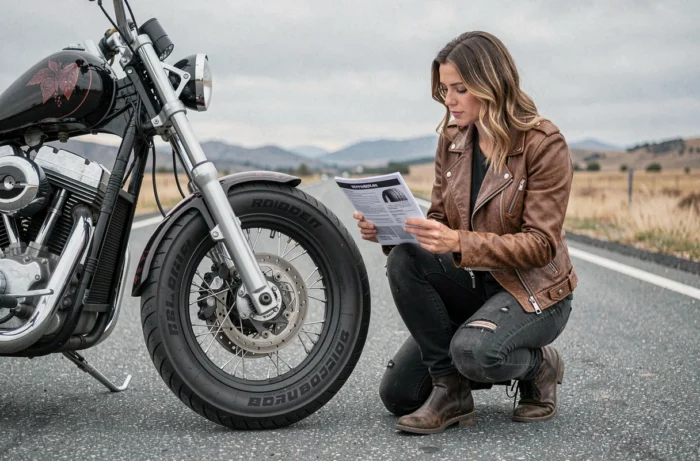
Brands like Michelin, Metzeler, or Dunlop offer ranges specifically designed for customs, with different compromises between longevity, grip, and aesthetics. Comparing user feedback on your specific motorcycle model remains the most reliable method to refine your selection.
The right tire for a custom is neither the widest nor the most beautiful on the rim. It is the one that respects the manufacturer’s indices, corresponds to your actual riding pace, and whose manufacturing date does not exceed the aging limit at the time of fitting. The production date, indicated in the form of a DOT code on the sidewall, remains the simplest reference to check before any purchase.