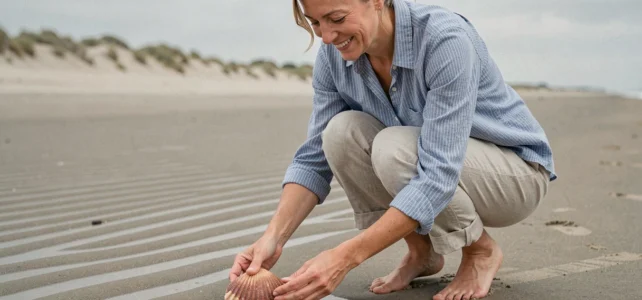
On the Landes coast, shellfish gathering faces a reality that the lists of “good spots” overlook: sanitary closures change from week to week, sometimes from day to day. A spot that is allowed on Friday may be banned on Monday after a rainy episode or a proliferation of Dinophysis. Before choosing a beach, the question to resolve is that of regulatory access on the same day.
Check the sanitary classification of a Landes spot before going
Recreational shellfish gathering areas are classified by the Nouvelle-Aquitaine regional health agency. This classification determines the authorization to collect clams, cockles, or razor clams in a given area. Prefectoral orders can suspend collection at any time, particularly after analyses reveal the presence of lipophilic toxins (DSP) related to the phytoplankton Dinophysis.
We observe that cooking does not neutralize DSP-type toxins. This point is often underestimated: bringing back shellfish from a temporarily closed area and then cooking them is not enough to make these shellfish safe to eat. DSP toxins withstand heat.
To identify a spot that is still authorized and safe on the same day, it is necessary to cross-reference several sources before leaving. The approach remains the same for each outing on the Landes beaches, and it is useful to consult La Top Liste online to identify areas that are usually productive.
- Check the ARS Nouvelle-Aquitaine website, which publishes the updated list of closures for shellfish gathering and swimming due to bacterial or phytoplankton contamination.
- Verify the current prefectoral orders on the Landes prefecture website. An order may target a specific intertidal zone without affecting the neighboring beach.
- Check the tide coefficients for the day: a coefficient that is too low does not expose enough intertidal area for the outing to be productive, and a high coefficient after heavy rains increases the risk of contamination from runoff.
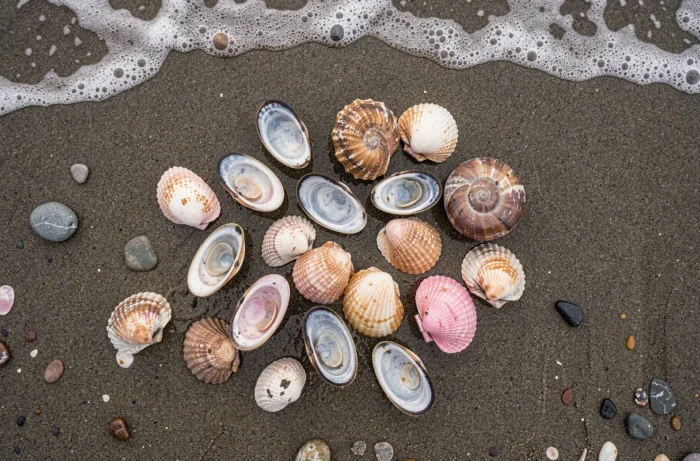
Sandy intertidal or pond mudflat: two types of spots in the Landes
The Landes department features a nearly straight coastline, exposed to the Atlantic swell, with very little rocky substrate between the mouth of the Adour to the south and the Arcachon basin to the north. This configuration directs shellfish gathering towards two distinct environments.
Ocean beaches at low tide
The large fine sandy beaches near Capbreton, Hossegor, or Biscarrosse offer an extensive intertidal area during high coefficients. Here, you mainly find cockles, donaces (tellins), and sometimes razor clams in the wet sand. The Landes swell constantly reshapes the sediment, making shellfish densities variable from one tide to the next.
Landes surfcasting and shellfish gathering share the same tide windows. The large tides with coefficients over 90 expose the most productive shellfish beds. We recommend targeting the two hours surrounding low tide to maximize the accessible intertidal area.
The shores of the Arcachon basin on the Landes side
The southern shore of the Arcachon basin, technically in Gironde but immediately bordering the Landes, constitutes a shellfish gathering spot of a very different nature. The mudflats and channels sheltered from the swell host clams, cockles, and periwinkles in a more stable substrate. The regulations here differ from those of the ocean coast: the oyster farming areas of the Arcachon basin are subject to specific sanitary classifications, updated by the Gironde prefecture.
Rain episodes and runoff: the trap of post-rain outings in the Landes
A common reflex is to take advantage of a lull after the rain to go fishing. On the Landes coast, this is precisely the most risky time from a health perspective. Coastal rivers (Huchet, Contis, Mimizan) drain runoff-laden waters rich in bacteria towards the intertidal zone.
Preventive closures often occur with a delay: analyses take several hours, and the prefectoral order may be published after shellfish gatherers have already frequented the area. Waiting at least 48 hours after a significant rain episode significantly reduces the risk of exposure to undetected bacterial contamination.
Sanitary measures can be lifted quickly and then reinstated locally, confirming a high variability from one area to another and from week to week. The example of La Baule bay, where a sector reopened on August 13, 2026, while other restrictions remained in effect nearby, illustrates this geographical granularity of prohibitions.
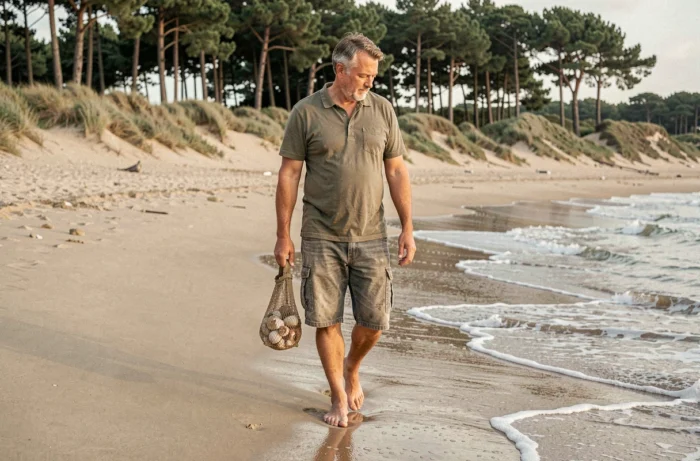
Regulations for recreational shellfish gathering on the Landes beaches
Beyond the sanitary classification, recreational shellfish gathering in the Landes is subject to specific harvesting rules. The minimum capture sizes are set by order and vary by species. The quantities allowed per person per day are capped.
- Clams and cockles must reach a minimum capture size defined by local regulations. A calibrator (sorting grid) allows for on-site verification.
- The collection of empty shells for decorative purposes is regulated: excessive harvesting of empty shells is prohibited, even if they are not intended for consumption.
- Permitted tools are generally limited to hand, rake, and small fork. Mechanized equipment is prohibited for recreational fishing.
- Shellfish gathering hours are not unrestricted everywhere: some areas impose time slots linked to tides or coexistence with oyster farming activities.
Collecting shellfish in the Landes remains an accessible pleasure, provided that each outing is treated as a same-day decision. The reflex to instill: check the sanitary status of the targeted spot before loading the bucket into the car, not the night before but on the same morning.