
A blood alcohol level of 2 grams per liter corresponds to a state of severe intoxication, well beyond the legal limit for driving. Reaching this level requires ingesting a quantity of pure alcohol that the body can no longer metabolize as it arrives. Understanding the calculation mechanism behind this figure helps to grasp why such a level endangers health.
The Widmark formula applied to blood alcohol calculation
The blood alcohol level cannot be guessed by the number of drinks consumed. It is calculated using the Widmark formula, which relates the mass of pure alcohol ingested to body weight and a diffusion coefficient specific to sex.
The formula is written as follows: blood alcohol level (g/L) = mass of pure alcohol (g) / (body weight in kg x diffusion coefficient). The coefficient is 0.7 for men and 0.6 for women, reflecting the difference in water proportion in the body.
To determine how much for 2 grams of alcohol, one must know precisely their weight, sex, and the amount of pure alcohol consumed. Without these three variables, any calculation remains approximate.
Calculating the mass of pure alcohol in a glass
Each alcoholic beverage contains a percentage of alcohol by volume indicated on the label. To convert this volume into grams, the density of pure alcohol is used: one liter of pure alcohol weighs 800 grams.
A 10 cl glass of wine at 12° therefore contains: 0.10 L x 0.12 x 800 = 9.6 g of pure alcohol, or about 10 g. This principle applies to all beverages: a 25 cl pint of beer at 5° gives 10 g, a 3 cl glass of whisky at 40° also gives about 10 g.
This equivalence explains the notion of standard drink: in France, a drink served in a bar theoretically contains the same amount of pure alcohol, regardless of the type of beverage, which is about 10 g.
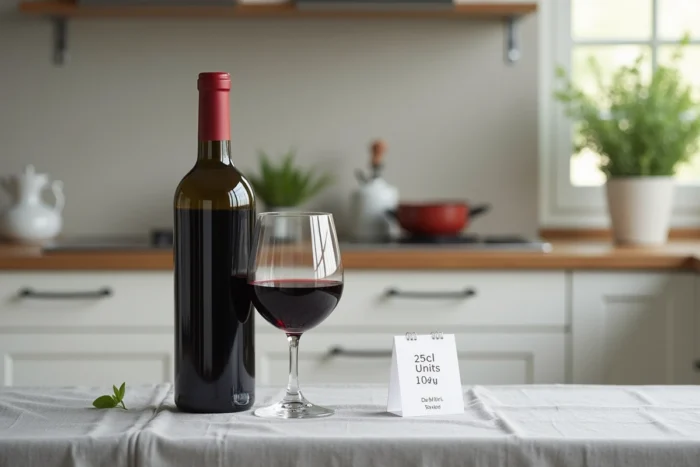
How many drinks to reach 2 g/L based on weight and sex
By reversing the Widmark formula, one can estimate the number of drinks needed to reach a theoretical blood alcohol level of 2 g/L. The result varies significantly depending on the profile.
Let’s take a man weighing 80 kg. To reach 2 g/L, the mass of pure alcohol needed would be: 2 x 80 x 0.7 = 112 g, or about 11 standard drinks. For a woman weighing 60 kg: 2 x 60 x 0.6 = 72 g, or about 7 standard drinks.
| Profile | Weight | Coefficient | Pure alcohol needed | Standard drinks (approximately) |
|---|---|---|---|---|
| Man | 80 kg | 0.7 | 112 g | 11 |
| Man | 65 kg | 0.7 | 91 g | 9 |
| Woman | 60 kg | 0.6 | 72 g | 7 |
| Woman | 50 kg | 0.6 | 60 g | 6 |
These figures assume that all drinks are consumed quickly, without elimination time. In practice, the body begins to eliminate alcohol as soon as it is absorbed, which alters the actual result.
Alcohol elimination and factors that distort the theoretical calculation
The liver eliminates alcohol at an average rate of 0.10 to 0.15 g/L per hour. This rate is constant: neither coffee, cold water, nor physical activity speeds it up. Nothing can accelerate the elimination of alcohol by the liver.
This means that a person who has reached 2 g/L takes between 13 and 20 hours to return to zero. Drinking over several hours reduces the peak blood alcohol level compared to rapid consumption, but the total amount absorbed remains the same.
Individual variables
The Widmark formula provides an estimate, not an exact measurement. Several factors modify the absorption and diffusion of alcohol:
- The state of the stomach: drinking on an empty stomach accelerates the passage of alcohol into the blood, as the absence of food reduces gastric residence time.
- The speed of consumption: drinking the same amount in one hour or over four hours does not produce the same peak blood alcohol level.
- Body composition: at equal weight, a person with more fat mass will reach a higher level, as fat does not retain alcohol like body water.
- The state of the liver: hepatic steatosis or chronic liver disease slows elimination capacity and increases exposure duration to a high level.
These variables explain why two people drinking the same amount do not reach the same level. The calculation remains an order of magnitude, never a guarantee.
Real health risks beyond 2 grams of alcohol in the blood
At 2 g/L, the effects on the body far exceed simple drunkenness. Motor coordination is severely impaired, reaction time is significantly prolonged, and judgment almost completely disappears.
Beyond this threshold, the risk of alcohol coma becomes real. Alcohol coma generally occurs around 3 g/L, but individuals with low body weight or reduced tolerance may be exposed as early as 2 g/L. Beyond 5 g/L, the vital prognosis is engaged.
Public Health France reminds in its 2026 strategy that there is no risk-free consumption threshold for alcohol. Even consumption considered moderate increases certain risks, particularly of cancers and cardiovascular disorders. Alcohol is also present in a very high proportion of violence situations, including sexual violence.

Blood alcohol level at 2 g/L and penalties under the highway code
In France, the legal limit for driving is set at 0.5 g/L of blood (0.2 g/L for probationary license holders). A blood alcohol level of 2 g/L represents four times the legal limit, which automatically categorizes the offense as a felony.
From 0.8 g/L, driving under the influence of alcohol constitutes a felony punishable by criminal sanctions. At 2 g/L, the withdrawal of 6 points, suspension of the license, and a heavy fine are systematic, with a risk of imprisonment in case of recidivism or accident.
The calculation of the number of drinks to reach a given level does not serve to define a margin of maneuver. The body does not react predictably, and the only physiological certainty remains the unavoidable time of elimination by the liver. Knowing the Widmark formula is primarily about measuring the gap between what one thinks they can control and what the body actually endures.