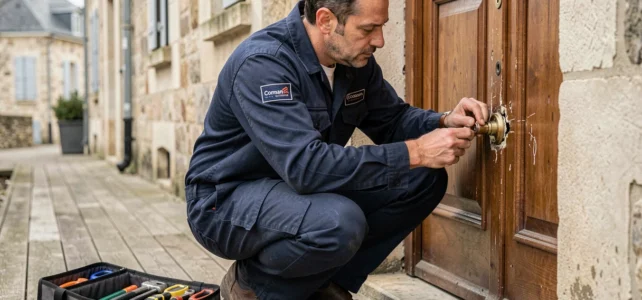
A European safety profile cylinder is not replaced like a mailbox lock. Locking mechanisms rely on millimeter tolerances, certification standards, and a recently tightened regulatory framework. Hiring a professional locksmith ensures compliance of the installed equipment, the longevity of the mechanism, and insurance coverage in case of damage.
A2P Standards and Lock Certifications: What Resistance Levels Change
An A2P certified lock (Assurance Prévention Protection) has undergone destructive testing in a laboratory. The classification is divided into three stars, each level corresponding to an increasing resistance time against a break-in attempt. We systematically recommend a minimum two-star A2P cylinder for the main entrance door of a residence.
The choice of certification level directly affects the insurer’s coverage. A multi-risk home insurance policy often requires a certified multi-point lock to compensate for a burglary. A professional locksmith is aware of these requirements and guides clients towards equipment suitable for their contract, avoiding a refusal of compensation due to non-compliance of the locking system.
La Serrurerie Valbusa exemplifies this type of structured service, with a diagnosis of the frame, recommendation of suitable cylinder, and installation in accordance with the manufacturer’s specifications.
Beyond the lock, the hardware of the door leaf must be compatible with the multi-point system. An improperly sized anti-pinch angle or an unsuitable cylinder protector nullifies the investment in a high-end lock. This pairing work cannot be improvised.
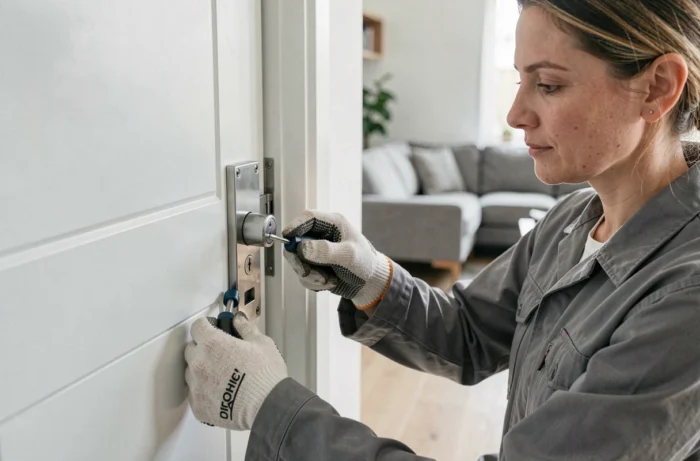
Mandatory Quote and Legal Framework for Locksmith Services
Since the decree of January 24, 2017, any home repair requires a written quote signed before intervention, regardless of the amount. The previous threshold of 150 euros has been removed. A detailed invoice must be provided from 25 euros including tax, with a breakdown of services and parts supplied.
These legal obligations are not trivial. A structured locksmith, with a verifiable SIRET and a physical address, produces these documents without difficulty. In contrast, opaque repair platforms regularly charge for unapproved services or inflate night rates without prior written justification.
Concrete Signals of a Reliable Provider
- A SIRET number that can be checked on the Sirene directory, associated with a real commercial address (not just a simple postal address).
- A paper or digital quote signed before any disassembly, mentioning the hourly rate, the price of parts, and the cost of travel.
- A professional liability insurance covering potential damages to the structure during the intervention.
- The absence of unsolicited telemarketing, a practice now prohibited for all companies since August 11, 2026.
The new ban on unsolicited telemarketing eliminates a historical channel for repair scams. A legitimate professional never calls an individual to propose a lock replacement.
Emergency Door Opening: Non-Destructive Techniques and Limits
Fine opening techniques (picking, bypassing, decoding) require specific tools and practical training of several hundred hours. On a standard pin cylinder, an experienced locksmith can open it without damage in a few minutes. On a three-star A2P cylinder with lateral pinning, the same non-destructive approach may prove impossible, necessitating targeted drilling of the cylinder.
The pre-intervention diagnosis determines the method and final cost. A professional assesses the type of cylinder, the state of the mechanism, and the door configuration before choosing their technique. This step avoids destroying an expensive multi-point lock when a fine opening was possible.
Common Cases That Complicate Intervention
A reinforced door with a surface-mounted lock and anti-removal angle leaves no room for a bypass tool. The locksmith must then work exclusively on the cylinder. If the key is broken inside the rotor, prior extraction requires a tool suitable for the key profile.
On connected locks with integrated motorization, an electronic failure cannot be resolved with a mechanical tool. The professional must know the manufacturer’s reset protocol or have access to maintenance software. Intervening without this expertise risks permanently blocking the module.

Installation of Multi-Point Locks: Technical Errors to Avoid
Installing a three-point surface-mounted lock on a lightweight particle board door weakens the door leaf at the top and bottom anchoring points. We regularly observe door warping after a few months, as the weight of the box and the tension of the rods work on the panel.
The choice between a surface-mounted lock, a mortise lock, or a cased lock depends on the thickness of the door leaf, the nature of the material, and the configuration of the frame. A mortise multi-point lock requires a door at least 40 mm thick made of solid or reinforced composite wood. Below this thickness, the mechanical resistance is insufficient.
The alignment of the bolts with the top and bottom strikes determines the smoothness of the locking. A misalignment of a few millimeters creates a hard point that, over time, deforms the rod system or prematurely wears out the central mechanism. A professional locksmith adjusts each strike with a chisel or portable router, then checks the residual play upon closing.
Replacing a lock is also an opportunity to check the condition of the hinges and the threshold. A door that sags by a few millimeters alters the alignment of all locking points. Correcting the issue at the source prevents the need for a return visit six months later for a locking issue that forces.