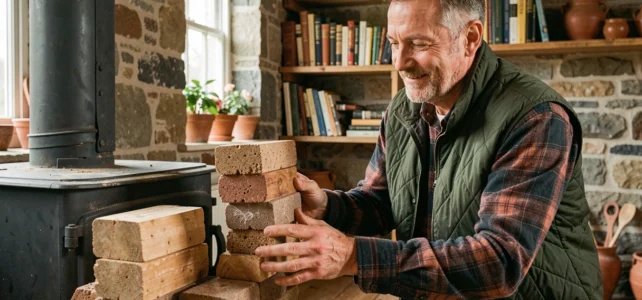
When loading a stove with a poorly dried traditional log, the glass gets dirty in less than an hour and the heat produced is disappointing. This observation often leads to testing the densified log. Made from sawdust and shavings compacted under high pressure, without chemical binders, it has a very low moisture content, well below what is obtained with split wood stored for two years under cover.
Regulated moisture content: what the 2022 decree changes for fuel choice
Since decree no. 2022-446 of March 30, 2022, firewood sellers must inform consumers about the moisture content of the proposed fuel. This obligation makes quality discrepancies much more visible at the time of purchase.
A classic log air-dried often hovers around 20 to 25% moisture, sometimes more when storage is inadequate. The densified log, on the other hand, drops below 10%. This is not a marketing argument: a low moisture content guarantees cleaner combustion and a significantly higher heat output for the same weight.
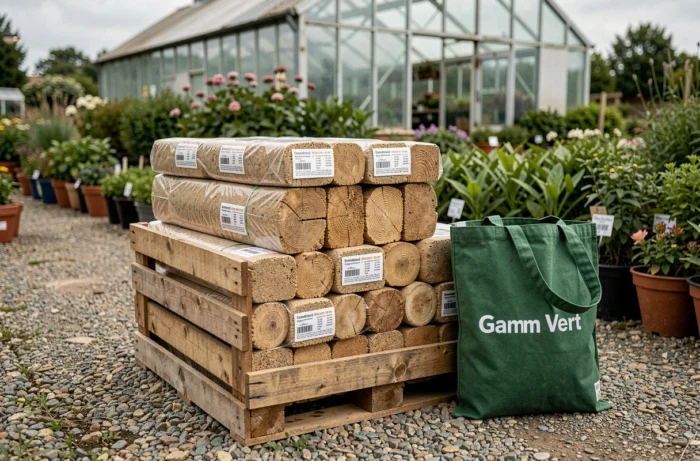
In practical terms, the difference is visible on the stove’s glass and in the flue. Less moisture means less soot, less tar, and more comfortable sweeping intervals. For those looking for firewood at Gamm Vert, the pallets of densified beech logs directly meet this regulatory requirement without needing to check anything with a moisture meter.
Calorific yield of the densified log compared to traditional firewood
It is often said that the compressed log costs more than the classic steres. This is true for the raw purchase. However, one ton of densified logs replaces about four steres of traditional wood in energy output.
The higher calorific value is explained by the density of the material. High-pressure compaction eliminates air pockets and concentrates the combustible material. The result: each log burns longer and emits a steady heat, without the peaks and troughs typical of split wood fires.
Long-lasting combustion and use in stoves or inserts
In a well-adjusted wood stove or insert, the densified log easily lasts more than two hours of regular combustion. Feedback varies depending on the installation and draft, but most users find they need to reload the firebox less often.
For overnight use, some so-called “long-lasting” compressed logs are specifically designed to maintain active embers for several hours. They can be distinguished from classic densified logs by their shape (often cylindrical and wider) and their even higher density.
Compact storage and handling: the logistical advantage in daily life
A ster of classic wood occupies one cubic meter when stored, and often more when the logs are irregular. Densified logs can be stored in a volume three to four times smaller for equivalent energy. In an apartment with a stove, in a narrow garage, or on a covered balcony, this compactness makes a difference.
Packs of compressed logs, usually packaged in ten-kilogram bundles, are easy to handle. No bark falling off, no insects, no wood dust on the floor. They stack like bricks, which simplifies storage.
Point of caution: sensitivity to ambient humidity
The main drawback of the densified log lies in its low water content. It absorbs ambient moisture like a sponge if stored improperly. A pack left in a poorly ventilated garden shed or placed directly on a damp floor quickly loses its combustion qualities.
- Store the packs indoors or in a perfectly dry location, elevated off the ground on a pallet or shelf
- Do not open the plastic packaging film before use to preserve the original moisture content
- Avoid uninsulated garages where winter condensation can deteriorate the fuel in a few weeks
Densified log and environmental impact: a fuel made from wood residues
The production of compressed logs utilizes by-products from the wood industry (sawmills, carpentries) that would otherwise be sent to landfill or burned without energy recovery. No tree is specifically cut down to produce densified logs.
This short valorization circuit reduces pressure on forests exploited for firewood. The shavings and sawdust used have undergone no chemical treatment, ensuring combustion without the emission of toxic compounds related to glues or varnishes.
Air quality and flue maintenance
Less smoke, fewer fine particles, less creosote in the flue: the combustion of very dry wood mechanically produces fewer pollutants than wet wood. For areas affected by air quality restrictions, particularly in valleys or urban areas, the densified log represents a coherent choice.
- Reduced ash production compared to classic wood, making firebox maintenance easier
- Stove or insert glass remains clean significantly longer between cleanings
- Limited deposits in the flue, contributing to spacing out mandatory cleanings
For a household that uses its stove or insert as primary or supplementary heating, switching to densified logs reduces maintenance time and improves thermal comfort without changing the appliance. The ranges available in garden centers, particularly the pallets of compressed beech, allow for stocking up for the entire heating season with controlled bulk.