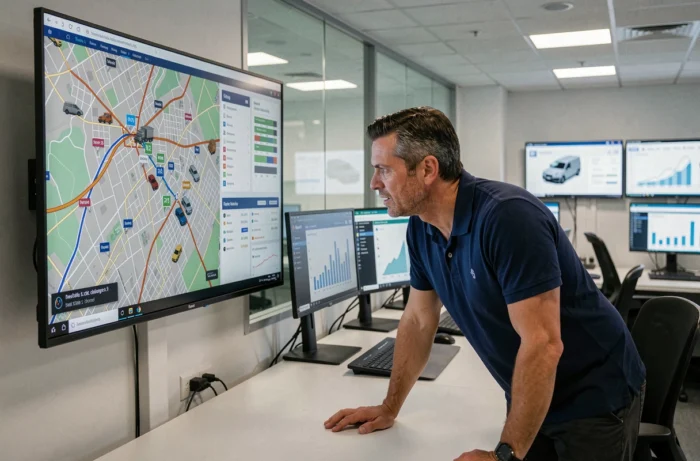
The French fleet management market has shifted in recent years from simply pinpointing locations on a map to integrated telematics platforms, combining engine data, driving style analysis, and remote diagnostics. The adoption of geolocation now far exceeds the road transport sector.
Integrated telematics: what GPS alone does not capture
A classic GPS unit transmits a position every few seconds. The raw data (latitude, longitude, speed) remains limited if not cross-referenced with other streams. Current platforms also retrieve vehicle diagnostic codes, tire pressure, engine RPM, or instances of harsh braking.
This overlay of data changes the very nature of monitoring. We no longer track a movement; we analyze mechanical and human behavior. A manager can detect excessive fuel consumption linked to aggressive driving style or anticipate an engine failure thanks to a real-time error code.
Understanding how GPS fleet tracking works thus requires going beyond mere geolocation to integrate this layer of telematics, which has become the norm for the majority of professional fleets.
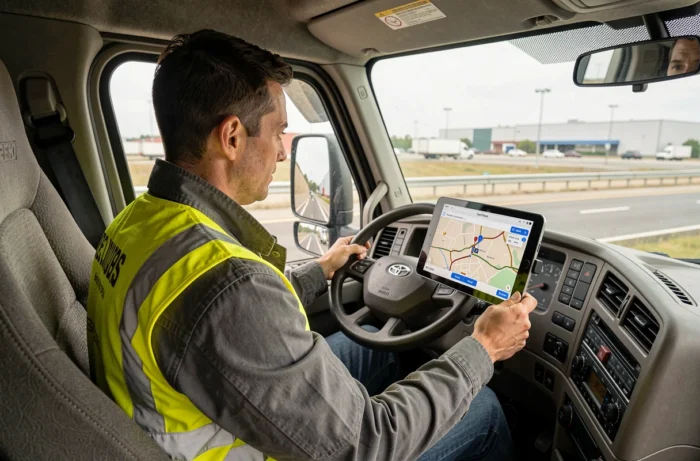
CNIL and GDPR framework: regulatory constraints of GPS fleet tracking
The geolocation of vehicles used by employees remains a sensitive issue in French labor law. The CNIL has imposed several sanctions as part of its simplified procedure against companies that do not comply with proportionality rules.
The principle is clear: an employer cannot use GPS to monitor working hours if less intrusive means exist. Permanent monitoring outside of service hours is prohibited, and employees must be able to deactivate location tracking during personal trips with a company vehicle.
Concrete obligations for the company
- Inform each driver of the purpose of the system, the data collected, and the retention period, before any deployment of the GPS tracker
- Conduct an impact assessment (AIPD) when tracking involves a large number of vehicles or intersects with sensitive data (schedules, driver identity)
- Provide distinct profiles for shared vehicles so that one driver cannot access the trip history of a colleague
- Implement a mechanism to erase the history upon resale or return of the vehicle
The recent recommendation from the CNIL on connected vehicles, although primarily aimed at private vehicles, sets a protection standard that influences the design of telematics solutions. Providers now incorporate the ability to remotely disconnect user accounts linked to the vehicle.
Driving data and reducing fuel costs
Field feedback shows that the reduction in fuel consumption is the quickest gain after deploying a tracking system. The explanation lies less in route optimization than in changing driver behavior.
When a driver knows that their harsh accelerations, late braking, and speeding are being recorded, they adjust their driving. Platforms generate individual driving scores, sometimes shared in the form of anonymized rankings within the team.
Predictive maintenance and vehicle lifespan
Remote diagnostics allow for the detection of engine anomalies before they cause a breakdown. An error code reported by the unit triggers an alert to the fleet manager, who schedules the workshop intervention without waiting for the failure.
Anticipating breakdowns reduces both repair costs and downtime, two significant expenses for a fleet of several dozen vehicles. The data accumulated over several months also helps identify the most reliable models and guide future purchases.

Legality of GPS evidence before labor courts
A often-overlooked angle concerns the use of GPS data as evidence in disputes with an employee. Recent case law reminds us that geolocation data obtained in violation of GDPR can be dismissed by the judge, even if it demonstrates employee misconduct.
An employer who dismisses a technician for false trip declarations based on a GPS tracker of which the employee was unaware risks having the evidence rejected. The labor court checks three points: was the employee informed, does the declared purpose correspond to the actual use, and is the data collection proportionate.
This requirement pushes companies to rigorously document their geolocation policy. A simple paragraph in the employment contract is not enough: a separate, updated information note and a processing register compliant with GDPR are necessary.
Autonomous fleets and the GPS tracking of tomorrow
Experiments with autonomous vehicles raise a new question: how to manage a fleet without a human driver on board. GPS then becomes the sole link between the vehicle and the supervision center. Position data, combined with onboard sensors, feed real-time decision-making algorithms.
Field feedback varies on the actual maturity of these systems for commercial fleets. The most advanced use cases involve shuttles on closed sites or last-mile deliveries in defined urban areas. For long-distance fleets, human supervision remains necessary at every stage.
GPS fleet tracking is no longer just a location tool. Its value depends on the quality of the cross-referenced data, adherence to regulatory frameworks, and the manager’s ability to transform this information into operational decisions. Companies that make the most of these systems are those that invest as much in team training and GDPR compliance as in the technology itself.