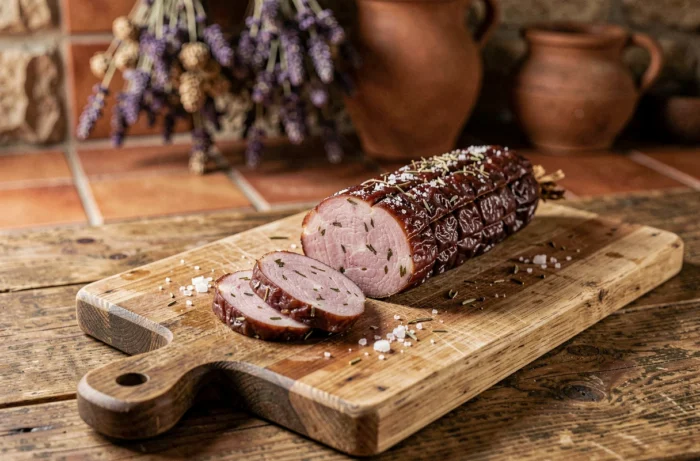
The maôche shares a distinctive trait with a few rare mountain dishes: it rests on an animal organ (the pig’s stomach) used as a cooking container, rather than as a mere ingredient. This principle, common in European pastoral cuisines, raises a concrete question: what distinguishes the Ardèche maôche from its charcuterie cousins, and why does this dish resist culinary trends?
Maôche, haggis, pansette: comparing stomach dishes
Several European culinary traditions use an animal stomach as a cooking envelope. The maôche belongs to this family, but its components and preparation method set it apart.
| Criterion | Maôche (Ardèche) | Haggis (Scotland) | Pansette de Gerzat (Auvergne) |
|---|---|---|---|
| Envelope | Pig’s stomach | Sheep’s stomach | Veal or sheep’s stomach |
| Filling base | Sausage meat, belly, bacon, cabbage | Sheep offal, oats, onions | Tripe, feet, vegetable stuffing |
| Dominant vegetable | Kale (very significant part) | No green vegetable | Swiss chard or cabbage depending on variations |
| Cooking method | Slow poaching, simmering water, several hours | Poaching or steaming | Braising in a casserole |
| Serving | Sliced, with potatoes | Opened at the table, with turnip puree | In slices or pieces |
The first visible difference concerns the amount of cabbage. The maôche incorporates a considerable quantity relative to the meat, giving it a lighter texture than what a “pork dish” might suggest. The haggis, on the other hand, derives its density from oats and chopped offal.
The second difference pertains to the envelope itself. The pig’s stomach, thicker and more resilient than the sheep’s stomach, can withstand a poaching of several hours without bursting, provided that the water never exceeds a simmer. This technical constraint conditions the entire final result.
To delve deeper into the origins and local variations, the Ardèche maôche on L’Entracte Gourmand details the journey of this dish in Ardèche gastronomy.
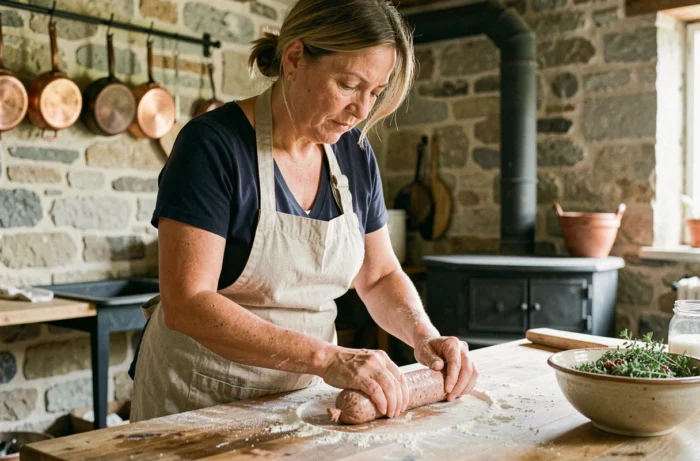
Cooking the maôche: why simmering changes everything
Most recipes emphasize one point: the water must never boil. This is not a comfort recommendation; it is a mechanical constraint. The pig’s stomach, sewn and swollen with the filling, retracts under excessive heat. The result, if the temperature rises too much, ranges from simple tearing to the complete bursting of the stomach in the broth.
Slow poaching, at a constant temperature just below the boiling point, produces a gradual thermal exchange. The fat from the bacon and belly melts slowly, infusing the cabbage and sausage meat, and transforming the filling into a homogeneous, melting mass, where each bite combines fat, vegetable fiber, and meat.
Cooking time and variables
Traditional recipes mention durations ranging from three to over four hours. The one from the Aubenas-Vals site mentions four to six hours. The discrepancy is explained by several factors:
- The thickness of the stomach, which varies according to the age and breed of the pig, slows down or speeds up the penetration of heat
- The volume of filling: a very full stomach requires a longer cooking time for the center to reach the right temperature
- The fineness of the chopped cabbage, which affects the speed at which it releases its water and mixes with the meat
The traditional cooking test consists of piercing the maôche: if the juice that flows out is clear, cooking is complete. A pink juice indicates that it needs to be cooked longer.
Ardèche terroir and the Goûtez l’Ardèche label: what the maôche says about the plateau
The maôche is not a generic French pork dish. Its geographical anchoring is evident in the list of its ingredients and in the timing of its consumption. It is a mountain dish, seasonal, linked to winter and the Ardèche plateau.
Kale, grown in the highlands, withstands frost and gains flavor after the first frosts. The belly and bacon come from locally raised pigs. Prunes, added in some versions, provide a sweet note reminiscent of southern meat-fruit pairings.
Brotherhood of the Maôche and local festivals
The structuring around this dish is facilitated by the Brotherhood of the Maôche, which organizes annual events dedicated to this culinary heritage.
These events are not mere festivities. They include maôche competitions, with professional and amateur categories, which help establish a reference recipe. The certified maôche Goûtez l’Ardèche meets specific criteria conveyed by the brotherhood.
Maôche or maouche: dual spelling and the same filling
Both spellings coexist in recent sources. “Maôche” with a circumflex accent dominates in tourist publications and labels. “Maouche” appears in oral usage and some commercial documents. This normalization of the dual name reflects the oral transmission of a dish that has never had a centralized written codification before the creation of the brotherhood.
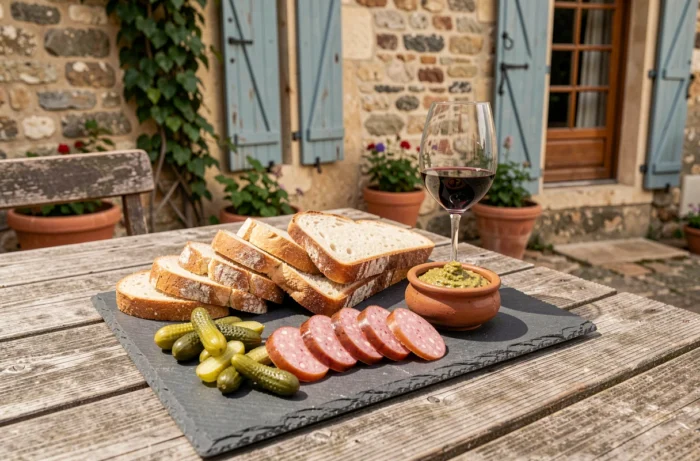
The word itself derives from the term for stomach in the local Occitan. Regardless of the spelling, the dish remains the same: a pig’s stomach stuffed with cabbage, sausage meat, and bacon, poached for a long time and served in thick slices with potatoes.
To date, the maôche does not have regulatory recognition of the AOP or IGP type. Its protection comes through the regional label Goûtez l’Ardèche and the work of the brotherhood, which maintains an informal but respected set of specifications among local artisans. This operation, based on direct transmission rather than a decree, explains both the vitality of the dish on the Ardèche plateau and its relative obscurity outside the region.