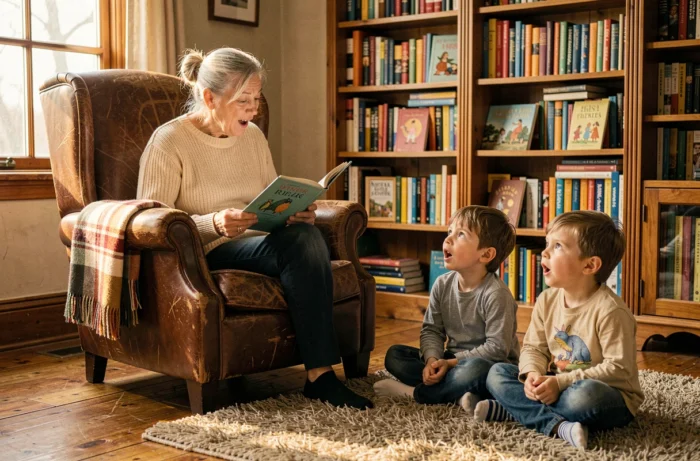
The frequency of shared reading between parents and preschool-aged children has sustainably decreased since 2020, according to a study by the National Institute for Early Education Research (Rutgers University) published in August 2026. This finding raises questions about the role of children’s stories in family life. Formats are multiplying, but the time dedicated to shared reading is not following the same trend. Understanding this gap helps in better choosing the stories to share as a family.
Shared reading decline: what recent data shows
The Rutgers University study, which focuses on preschool-aged children in the United States, indicates that frequent reading at home has not returned to pre-pandemic levels. The habits established during lockdowns, which were more screen-oriented, have persisted well beyond 2020.
Field reports diverge on the exact causes, but screen time and competition from audio or video content appear in most analyses.
This reality prompts a rethinking of the selection of children’s stories. Instead of creating yet another list of classics, it becomes relevant to seek stories that fit the real constraints of families: short duration, engaging narration from the very first sentences, and the possibility of shared listening. Online catalogs like histoire-enfant.fr gather texts designed for this type of quick daily reading.

Audio stories for children or reading aloud: two distinct practices
The youth podcast is experiencing notable growth. Bayard Jeunesse has an audio catalog structured by age group, from Petit Ours Brun to Belles Histoires, with several formats suitable for ages 3-12.
Audio offers concrete advantages:
- The child develops their imagination without visual support, which further engages the mental construction of images
- The format allows for listening in the car, at bedtime, or during quiet time, without requiring continuous adult involvement
- The vocabulary heard in a well-written story enriches the child’s lexicon without apparent effort
However, independent listening does not replace shared reading. Dialogic reading, where the adult asks questions, rephrases, and allows the child to anticipate what comes next, produces positive effects on vocabulary and narrative comprehension in preschool-aged children. These effects are documented even with low intensity of practice.
The distinction matters. A child listening to a podcast alone and a child reading a picture book with a parent do not engage the same skills. Audio complements shared reading but does not replace it in terms of language development.
Choosing children’s stories by age and reading time
Online catalogs often classify stories by age (0-3 years, 3-5 years, 6-8 years, 9-12 years). This segmentation, used by Storyplay’r or Bayard Jeunesse, has the merit of clarity. It masks at least one variable that is equally determining: the time of day.
An evening story does not have the same constraints as a story listened to during a trip. In the evening, the narration should slow down, sentences should simplify, and the resolution should be reassuring. During the day, an adventure story or a suspenseful mystery captures attention better. Children request different stories depending on the context.
Here are some concrete criteria to guide the choice:
- For bedtime: favor stories of less than ten minutes, with a soothing resolution and a descending narrative pace
- For trips: series with short episodes (mysteries, adventures) maintain attention over several days
- For shared reading on weekends: long illustrated books, with rich double pages, allow for real exchange time between adult and child
- For autonomy: audiobooks recorded by a relative or teacher create an emotional bond that professional versions do not replicate

Accessibility of children’s books: a still underexplored angle
The issue of digital accessibility of children’s books is gaining traction on a regulatory level. Print, audio, and digital versions do not offer the same level of access to children with disabilities.
An accessible audiobook is not simply a text read aloud. It requires adapted navigation, sound cues, and sometimes a description of illustrations. Not all mainstream platforms offer these features, and the available data do not allow for conclusions about the actual level of accessibility of most online children’s catalogs.
For concerned families, checking compatibility with screen readers and the presence of alternative descriptions remains a necessary step before committing to a subscription.
Classic tales and contemporary stories: should we choose?
The tales of Grimm, Perrault, or Andersen hold a stable place in parental recommendations. Their narrative structure (initial situation, trial, resolution) forms a foundation that children integrate early. Contemporary stories, on the other hand, address themes absent from the classics: diversity, complex emotions, modern daily life.
The two formats complement rather than oppose each other. A child who knows Little Red Riding Hood and also listens to a series of podcasts about a clumsy fairy builds a broader narrative repertoire. The variety of registers, from the marvelous to the realistic, nourishes both world understanding and vocabulary.
The most reliable selection criterion remains regularity. A short story shared every evening, even for a few minutes, has more effects on language and family bonding than an occasional long session. The best children’s stories are often those that fit within the available time.