Saignac poses a cartographic problem even before it becomes a tourist subject. According to sources, the name refers at times to a micro-commune in the South-West, at times to Salignac-Eyvigues in Dordogne, and at times to the fictional town from the series Commissaire Magellan.
This ambiguity informs the very nature of the place: a territory that escapes the radar of aggregators, without a dedicated tourist office or a well-developed Wikipedia page, and whose appeal lies precisely in this absence of staging.
Real Topography of Saignac: What Guides Don’t Geolocate
The primary difficulty for visitors is to locate Saignac with certainty. Several platforms confuse the commune with Savignac (Gironde), Saignon (Vaucluse), or even Salignac-Eyvigues (Dordogne). This confusion is not trivial: it reflects the absence of Saignac in institutional tourist databases.
For travelers looking for a stopover in the South-West without a pre-formatted itinerary, this documentary gap becomes a natural filter. Only those willing to navigate without digital markers end up visiting. We observe that this mechanism of selection through research effort produces a very homogeneous visitor profile: walkers, cyclists, enthusiasts of vernacular heritage.
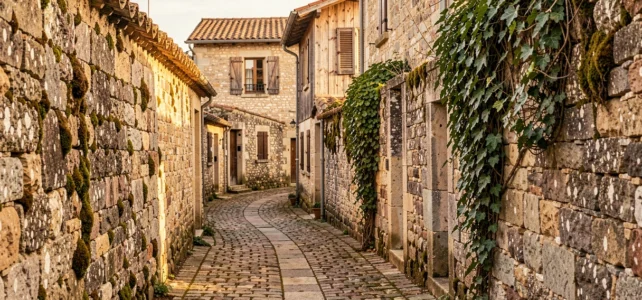
Those wishing to explore the commune of Saignac in France discover a network of unreferenced communal paths on mainstream apps, dry stone walls, and rural buildings that have not undergone any standardized heritage renovation.

Slow Tourism in Saignac: A Territory Without Packaged Offers
Online guides that describe Saignac as an “unforgettable” destination never specify what one can actually do there. The reason is simple: there is no structured tourist offer in the commune. No guided tours, no museum, no marked trails.
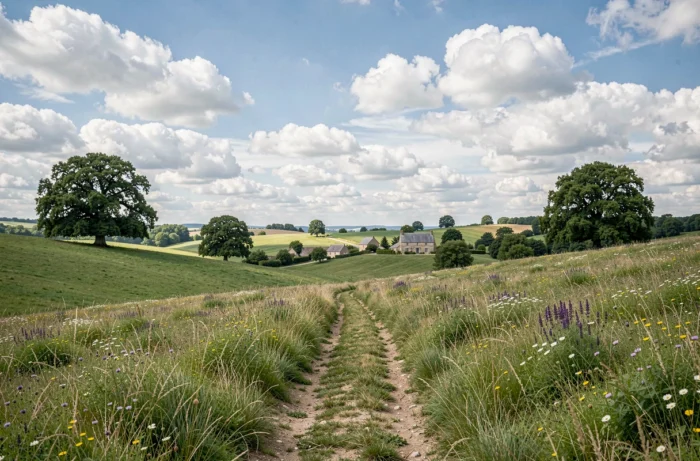
This is exactly what attracts a growing segment of travelers. Slow tourism, as practiced here, does not rely on a program of activities but on the direct reading of the landscape. The hilly topography of the area, the low-flow rivers, and the dirt paths between hamlets constitute the entirety of the experience.
What the Terrain Offers Without Mediation
- Unmapped communal trails on major hiking platforms, accessible by foot or mountain bike, crossing agricultural plots still in use
- A network of dry stone walls and vineyard huts whose state of preservation varies, offering a glimpse into pre-consolidation rural architecture
- Natural swimming spots on nearby rivers, without facilities or supervision, accessible only through local knowledge
- A measurable silence: the absence of a through departmental road eliminates motorized background noise for most of the day
We recommend considering Saignac not as a final destination but as a gateway to a micro-territory without tourist signage. The stay is built through walking, not by consulting a brochure.
Saignac and the Series Commissaire Magellan: Untangling Fiction and Geography
An additional factor of confusion comes from the television series Commissaire Magellan, which is set in a town called Saignac. This town is entirely fictional.
The Saignac of Commissaire Magellan has no geographical link to the real commune. The series uses sets to create an imaginary urban backdrop. This overlap between television fiction and real territory fuels confusion in search engines and automatically generated content.
For the traveler, this distinction is fundamental. Searching for “Saignac tourism” leads to articles about the television production as well as content about Périgord. Sorting between the two requires careful reading of sources, which again filters the audience towards the most determined visitors.
Accommodation and Access Around Saignac: Logistics of an Off-Grid Stay
The accommodation offer in the commune itself is almost non-existent in terms of traditional hotel capacity. Options are concentrated on rural gîtes and guest rooms in neighboring communes, with small capacity structures that are not always listed on booking platforms.
Preparing for a Stay Without Dedicated Infrastructure
The nearest road access point depends on the exact location chosen (South-West or otherwise). In any case, there is no train station or public transport stop directly serving the commune. A personal vehicle remains the only reliable means of access.
Food supplies are obtained in nearby towns. Mobile network coverage can be intermittent depending on operators and the terrain configuration. These constraints, perceived as obstacles by conventional tourism, serve as guarantees of tranquility for advocates of disconnected tourism.
- Prefer communal gîtes or specialized platforms for rural accommodation rather than large aggregators
- Plan for food autonomy for the first few hours, as local shops have limited hours
- Check network coverage before departure if a connection is necessary for work or safety
Saignac remains a territory where the visitor’s experience directly depends on their ability to accept the unexpected and the absence of a framework. Articles promising an “unforgettable” adventure without mentioning these logistical realities miss what makes the place unique: a stay that is earned through preparation and curiosity, not through online booking.