
Fragrancing a homemade soap without using essential oils means choosing ingredients whose scent withstands saponification. Most natural additives lose their fragrance when heated or in contact with lye, which makes the result disappointing if one does not understand this mechanism. This article compares the main alternatives available, their scent retention, and the conditions under which they actually work.
Scent retention of alternatives to essential oils in cold process soap
The first instinct when wanting to avoid essential oils is to turn to pantry ingredients: spices, zests, flower powders, aromatic extracts. Their behavior in cold saponification differs radically.
| Ingredient | Initial Intensity | Retention after Cure | Main Actual Use |
|---|---|---|---|
| Botanical powders (lavender, rose, hibiscus) | Low to medium | Very low | Coloring, texture |
| Dried citrus zests | Medium | Low | Light exfoliation |
| Spices (cinnamon, turmeric, cocoa) | Medium to strong | Variable (cinnamon holds better) | Coloring, light scent base |
| Cosmetic fragrances without EO | Strong | Good to very good | Long-lasting fragrance |
| Fragrant oil macerates (vanilla, coffee) | Medium | Low to medium | Care, coloring, subtle base |
This table highlights a major gap: botanical powders rarely scent soap in a lasting way. They primarily serve as colorants or texturizers. Guides that present them as olfactory alternatives to essential oils often overlook this point.
Those looking to scent their homemade soaps without essential oils benefit from clearly distinguishing between what colors and what scents, lest they multiply attempts without satisfactory results.
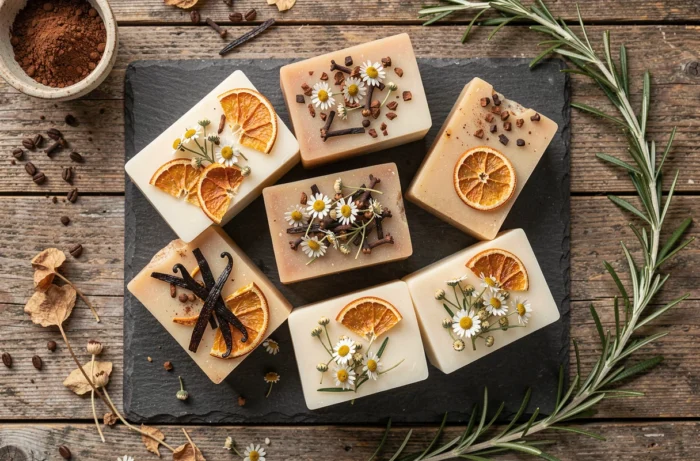
Cosmetic fragrances for soap: what the technical sheet changes
Cosmetic fragrances (sometimes called “fragrance oils”) are the most reliable alternative in terms of retention. They are formulated to withstand the alkaline pH of cold saponification, where a food extract or cooking flavor degrades.
Difference between cosmetic fragrance and food flavor
A food flavor is designed for an acidic or neutral environment (baking, beverages). When immersed in a soap paste with a pH that far exceeds neutrality, it loses almost all of its scent. Only fragrances tested for saponification retain their olfactory profile after several weeks of curing.
Before purchasing, check the supplier’s technical sheet to ensure the product is compatible with the cold process. Some specialized manufacturers (like those from Grasse or other historical perfume regions) specify the recommended dosage and behavior in trace.
Dosage and timing of addition
The fragrance is incorporated at a fine trace, when the paste begins to thicken slightly. Adding too early exposes the fragrance to prolonged reaction with the lye. Adding too late prevents even distribution.
- Respect the incorporation rate indicated by the supplier, usually expressed as a percentage of the total weight of oils
- Mix with a spoon rather than an immersion blender to avoid uncontrollably accelerating the trace
- Pour quickly into molds after incorporation, as some fragrances accelerate the setting
A fragrance that accelerates the trace can solidify the paste in a matter of seconds. Testing on a small batch allows one to anticipate this behavior before losing an entire batch.
Oil macerates and infusions: a subtle scent, not a powerful fragrance
Macerating vanilla, coffee beans, or zests in a vegetable oil for several weeks produces a macerate whose scent is perceptible in its raw state. However, once integrated into the saponification recipe, this fragrance diminishes significantly.
The oil macerate works better as a subtle scent base rather than as the main fragrance. A soap formulated with a vanilla macerate in coconut oil, for example, will emit a sweet but light note, far from the intensity of a cosmetic fragrance.
This option is suitable for those who prefer a nearly neutral soap, with just a hint of natural scent. To achieve a more pronounced result, combining a macerate with a small dose of cosmetic fragrance allows for a natural aromatic profile while ensuring adequate retention.
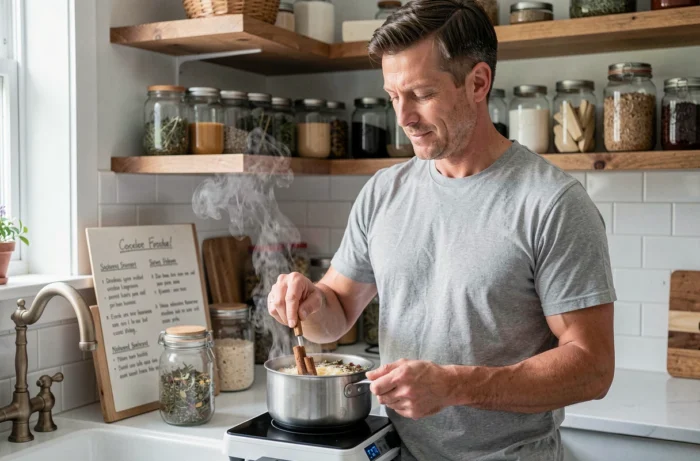
Melt and pour base: scenting without managing saponification
Melt and pour soap bases completely bypass the lye issue. Saponification has already been done by the manufacturer. The addition of fragrance is done in a melted base at moderate temperature, which preserves the olfactory compounds much better.
An additive that does not survive saponification can work very well in melt and pour. This is the case for many natural aromatic extracts, concentrated hydrosols, or even certain food flavors that degrade in a classic cold process.
Some melt and pour bases are formulated to remain very low in odor, precisely to allow added fragrances to shine. Checking the composition of the base before purchase prevents ending up with a background scent that conflicts with the chosen additive.
- Melt the base in a double boiler or microwave in short intervals
- Add the fragrance when the base is melted but not hot, to limit the evaporation of volatile notes
- Pour into molds without too much stirring to avoid air bubbles on the surface
Melt and pour does not replace cold saponification in terms of control over oils and personalized superfatting. However, for those primarily seeking a scented soap without essential oils and without handling lye, it is the most accessible process.
Soap without fragrance or soap without essential oils: a distinction to be made
A soap formulated without essential oils is not necessarily a soap without scent. Vegetable oils themselves have an olfactory profile: olive oil smells like olive, shea butter has a characteristic note, coconut oil exudes a recognizable sweetness.
This distinction between “without added fragrance” and “without essential oils” has practical implications. A cold saponified soap with a generous superfat of cocoa butter, for example, retains a light chocolate scent without any fragrance being added. Choosing base oils for their natural scent is already a form of fragrance.
For sensitive skin or those who avoid essential oils for health reasons, working with scent through the selection of fats rather than additives remains the simplest and least risky approach. The result will always be subtle, but authentic.