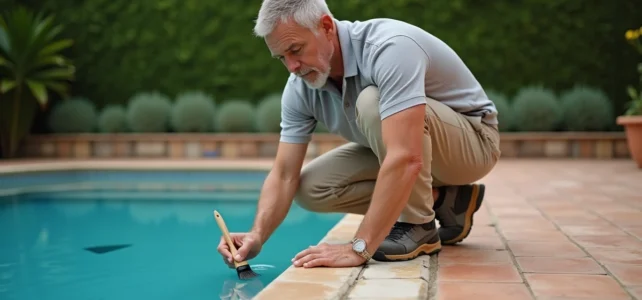
The liner is peeling, the coping stones are crumbling, the filtration is struggling: the reflex would be to tear everything down and start from scratch. Most of the time, completely replacing your pool costs more and takes longer than renovating what can be salvaged. Several solutions allow you to give a second life to an aging pool without going through demolition.
Reinforced PVC Membrane: Restoring Waterproofing Without Touching the Structure
Have you noticed damp spots around the pool or a regular drop in water level? The problem often lies with the waterproofing, not the structure itself. Before considering a replacement, it’s important to distinguish between the two.
The reinforced PVC membrane is installed directly over the old support, whether it’s concrete, an old liner, a coating, or even tiles. Specifically, a technician cuts the membrane to size, welds it on-site, and covers the entire pool. The result is a new watertight shell, without having to dismantle a single wall.
This type of renovation significantly reduces the duration of the project compared to a reconstruction. The garden remains accessible, and heavy excavation is eliminated from the equation. To explore pool alternatives on Univers du Bricolage, this technique is among the most documented by industry professionals.
A technical point to remember: the reinforced PVC membrane adapts to free-form shapes as well as classic rectangular pools. It also corrects small surface defects of the existing support, which avoids a complete leveling.
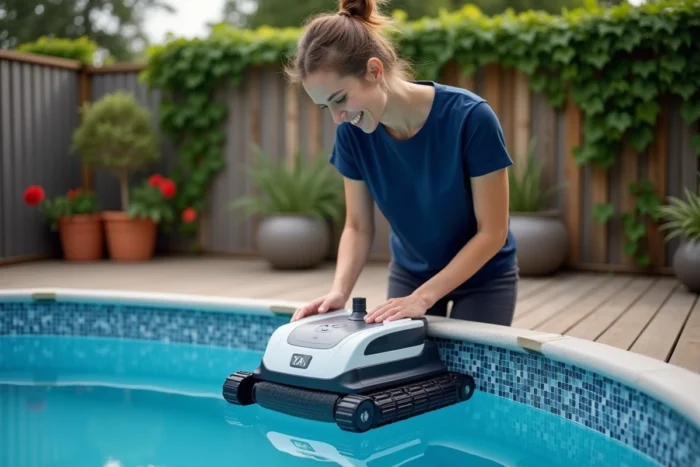
Modernizing Filtration and Water Treatment
A pool that turns green quickly, a noisy pump, an electricity bill that rises every summer: these signals indicate outdated equipment, not a pool at the end of its life. Replacing the filtration system costs a fraction of the price of a new pool, and the savings can be seen from the first season.
Variable Speed Pump and Efficient Filtration
Old pumps operate at a constant speed, even when the pool doesn’t need it. A variable speed pump adjusts its flow according to actual demand. It runs slower at night, speeds up during swimming, and consumes significantly less energy throughout the season.
On the filtration side, switching from a traditional sand filter to a glass or cartridge filter improves water quality and reduces the frequency of backwashing. Less backwashing also means less wasted water.
Automated Treatment and Alternatives to Chlorine
Automating water treatment simplifies daily maintenance. A pH regulator coupled with a salt electrolyzer or a UV system keeps the water healthy without constant manual intervention. The concrete advantages include:
- Less handling of chemicals (chlorine, pH minus, algaecide), thus less storage and risk
- Softer water for skin and eyes, particularly appreciated by children
- Weekly maintenance reduced to a few minutes of checking instead of daily tests and adjustments
These systems connect to the existing technical room. The pool structure, buried pipes, and lining remain in place.
Renovating Surroundings to Transform the Swimming Space
Sometimes, it’s not the pool itself that poses a problem, but everything surrounding it. Cracked coping stones, a grayish concrete deck, nonexistent lighting: the whole gives an impression of dilapidation while the pool still functions properly.
Requalifying the surroundings transforms the experience without modifying the pool. The principle is simple: we intervene around the pool, not inside it. Several areas of work can be combined depending on the budget and the condition of the site:
- Replacing coping stones with contemporary materials (reconstituted stone, composite wood, ceramic stoneware) that modernize the visual aspect in just a few days
- Adding LED lighting around the deck and in the pool to extend evening use and enhance safety
- Targeted vegetation with plants suited to wet areas, creating a natural ambiance without invasive roots
- Installing a platform or casing around an above-ground pool to visually integrate it into the garden
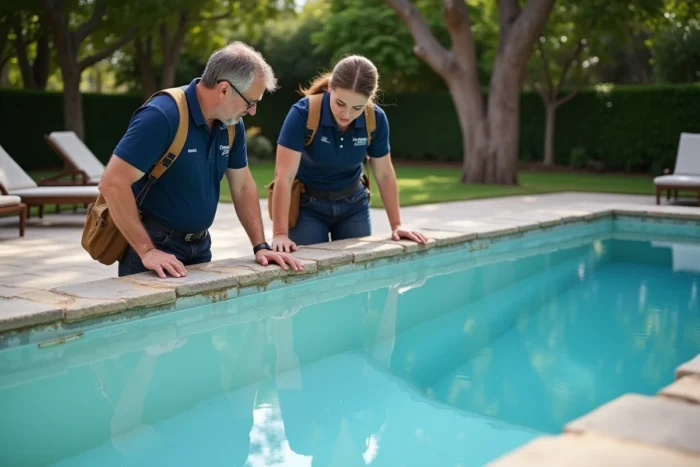
These improvements typically do not require building permits or deep excavation in most cases. The project duration is measured in days, not weeks.
Adapting the Depth and Access of the Existing Pool
Your pool is two meters deep, but no one ever dives? This discrepancy between actual use and the pool’s configuration leads some owners to consider replacement. However, the solution is more targeted.
Recent projects show that it is possible to reduce the depth of an existing pool by pouring a slab on the bottom or adding a false bottom. The water volume decreases, which lightens the consumption of treatment products and heating time.
In the same vein, adding a submerged area like a beach (gentle slope at the pool entrance) or modifying the access stairs radically changes the comfort of use. Children and people with reduced mobility can access the pool without a ladder, and the shallow area becomes a full relaxation space.
Combining a depth adaptation with safety standard upgrades (barrier, alarm, cover) allows for modernizing the pool in functional and regulatory terms in a single intervention.
Before signing a demolition quote, a precise diagnosis of the structure, waterproofing, and equipment often suffices to identify areas for renovation. A pool that is twenty years old is not necessarily a pool to be replaced: it is a pool waiting for the right work, in the right place.