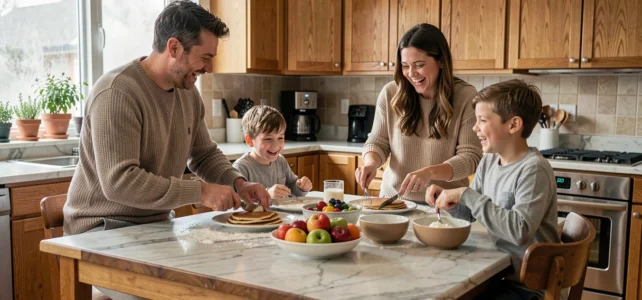
A parent who works remotely two days a week does not experience the same daily life as a parent who is absent for ten hours a day. Meals change, the noise in the house does too, and the availability perceived by children creates new expectations. Organizing a fulfilling family life starts with accepting that material conditions (space, schedules, fatigue) dictate a large part of what works or not.
Hybrid remote work and family rhythm: what changes concretely at home
Since the hybrid model has taken hold in France, with about two days of remote work per week as the dominant form according to a note from Insee published in May 2026, family routines have been reshaped. The parent present physically is not necessarily available, and this is where friction arises.
You can discover the Chronique Française website to delve into these questions related to parenting and family life, but the ground reality remains the same: the boundary between professional and personal life becomes porous when working from the living room.
The 2026 Mental Health and QVCT Barometer provides useful insights: from two days of remote work per week, it offers psychological protection (more autonomy, less distress). On the other hand, full remote work is associated with increased isolation and anxiety. For couples and children, this means that a well-framed hybrid rhythm improves parental availability, but a parent locked in their office five days a week risks being more stressed than at the office.
In practice, it’s beneficial to set visible rules: closed door during video conferences, shared lunch breaks with children if possible, and a clear end to work (shutting down the computer, changing rooms). A physical signal marking the end of the day helps the whole family transition to shared time.
Daily task distribution: stepping out of autopilot
Most couples operate out of habit. One manages meals, the other homework, and no one reassesses the workload until fatigue explodes. The problem is not the quantity of tasks, but the absence of regular discussion about who does what.
The mental load is not just a question of volume
Planning medical appointments, anticipating grocery shopping, remembering that the swimsuit needs to be in the bag by Thursday: this anticipatory load often falls on one parent. Delegating a task without delegating the planning does not reduce the mental load.
An effective approach: a ten-minute weekly check-in (on Sunday evening, for example) to list what’s coming up in the week and distribute tasks out loud. Feedback varies on this point, but families that try this ritual report less tension related to forgetfulness.
Involving children according to their age
A four-year-old can set the table. An eight-year-old can pack their bag alone if given a visual list. We are not talking about punitive chores, but participation in collective functioning.
- Before six years: tidying up toys, carrying their plate to the sink, watering a plant. The goal is habit, not perfection.
- Between six and ten years: preparing their bag, helping to set the table, sorting laundry by color. A rotating responsibility chart can be displayed.
- After ten years: cooking a simple meal once a week, managing their alarm, participating in grocery shopping with a list. Autonomy is built through regular micro-responsibilities.
Family communication: concrete tools rather than vague principles
Simply saying “we need to communicate better” is useless if we don’t know where to start. Families that function well are not those that talk the most, but those that have suitable conversation formats.
A simple format to try at dinner: each family member shares a pleasant moment from their day and a difficulty. No comments, no imposed solutions. This ritual creates a listening space that, when repeated, allows children to express a problem before it becomes a crisis.
For couples, the challenge is often finding an uninterrupted moment. Waiting for the children to sleep to discuss a sensitive topic works poorly when both parents are exhausted. It’s better to block a short slot (fifteen minutes) early in the evening, before fatigue takes over.

Shared family activities: prioritizing regularity over spectacular
Exceptional outings (amusement parks, trips) create memories, but they do not structure daily life. What strengthens family bonds is the repetition of simple, predictable moments.
- A walk on Saturday morning, always in the same neighborhood or woods. Children eventually have their landmarks, their favorite spots.
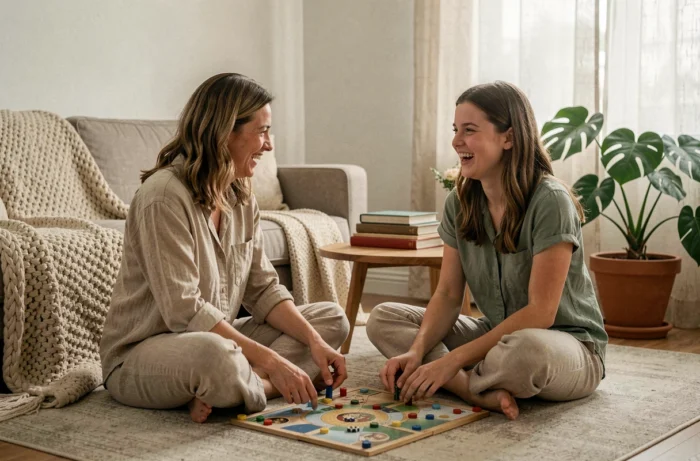
- A board game on Friday night, chosen in turn. The ritual matters more than the game itself.
- Cooking together on Sunday: even a basic cake occupies hands and frees conversation. The richest conversations often happen when we are not looking directly at each other.
The regularity of a family ritual matters more than its originality. A child who knows that Friday night is “their” time develops a sense of security that occasional outings cannot replace.
The classic trap is wanting to fill every weekend with activities. Children also need unstructured time to play alone, be bored, and invent. Leaving empty slots in the family agenda is not a failure of organization; it is an educational choice.
A fulfilling family life does not rely on a single model. It is built with the real constraints of each household: available space, work schedules, children’s temperaments. Adjusting habits in small increments produces better results than rethinking everything at once.