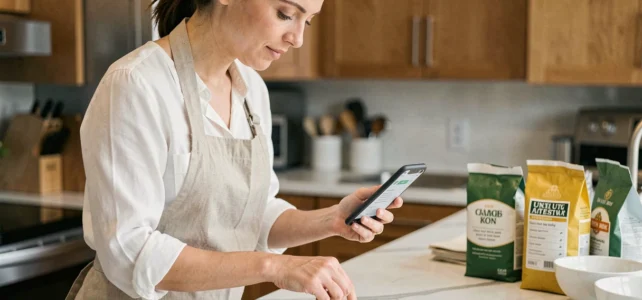
The conversion of mass in cooking relies on a parameter that most consumer converters handle poorly: the apparent density of each ingredient. A cup of flour and a cup of honey do not weigh the same, and two different types of flour do not share the same density. Understanding this mechanism changes the reliability of each conversion.
Apparent Density: The Technical Parameter That Converters Over-Simplify
A reliable mass converter does not multiply a volume by a single coefficient. It applies a density specific to the selected ingredient. Packed wheat flour in a container does not occupy the same volume as the same flour aerated after sifting.
Some recent online tools, like Tare: Kitchen Companion, rely on density databases verified by professional sources. Others use the apparent density data published by the Food and Agriculture Organization of the United Nations. The difference in results between a converter that uses a generic density and another that distinguishes light flour and packed flour can reach several tens of grams per liter.
We recommend systematically checking if the chosen tool specifies the exact nature of the ingredient. A field that simply offers “flour” without distinguishing T45, T65, or whole flour introduces a significant margin of error, especially in baking where every gram counts.
For a tool that manages these distinctions without hassle, the converter on the Mon Blog Cuisine site offers a step-by-step operation suited for those who are new to these concepts.

Mass Converter and International Recipes: The Cup Trap According to Country of Origin
An American cup is not equivalent to an Australian cup. The US cup corresponds to a slightly different volume than the British imperial cup, and the Australian tablespoon is larger than its North American equivalent. Ignoring the country of origin of a recipe skews all conversions to grams.
Services like Bakemetric now require users to indicate the geographical origin of the recipe before starting any conversion. This preliminary setting adjusts the size of cups and spoons to local standards, then converts the entire list of ingredients into grams.
If you are reproducing an American, British, or Australian recipe, this step is not optional. We regularly observe notable discrepancies in the quantities of liquids (water, milk, oil) and dry ingredients (flour, sugar) when the geographical standard is misconfigured.
Checks to Perform Before Converting a Foreign Recipe
- Identify whether the recipe uses US cups, imperial cups, or Australian metric cups, as the volumes differ between these three standards.
- Check the spoon unit: the Australian tablespoon contains a larger volume than the North American tablespoon.
- Prefer a converter that explicitly asks for the country of origin rather than a tool that applies a single default standard.
Volume-Mass Conversion in Cooking: When the Scale Remains More Reliable Than the Converter
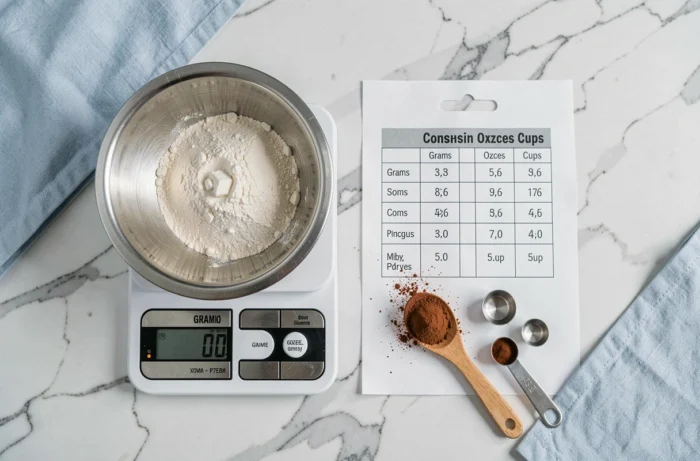
A mass converter provides a theoretical result calculated from an average density. A kitchen scale gives the actual weight of the ingredient you have in front of you. For technical baking, the scale always prevails.
The converter is particularly useful in two specific cases. The first: you do not have a scale and the recipe indicates grams. The second: the recipe uses foreign volumetric units (cups, tablespoons) and you need to obtain quantities in grams to weigh with your usual equipment.
Outside of these situations, converting grams to milliliters to use a measuring cup introduces unnecessary approximation. Powdered sugar, for example, can vary in density depending on its granulation. Oil and milk are accurately measured by volume, but dry ingredients like flour or almond flour are better weighed directly.
Ingredients Where the Converter is Reliable and Cases Where It Is Not
Homogeneous liquids (water, milk, oil) have a stable density. The volume-mass conversion is then accurate and reproducible. For these ingredients, an online converter is sufficient.
Powders and granular ingredients pose more problems. Sifted flour can weigh significantly less per liter than unsifted flour. Cocoa powder, starch, and powdered sugar present similar variations. When precision is critical (meringue, macarons, choux pastry), we recommend weighing rather than converting.
Choosing the Right Mass Converter for Cooking: Selection Criteria
Not all online converters are created equal. Some only handle standard masses and volumes (grams, kilograms, milliliters, liters). Others incorporate kitchen utensils like teaspoons, tablespoons, and cups, with equivalents tailored to each ingredient.
- The converter should offer a selection by ingredient rather than a generic conversion based on the density of water.
- The unit management should cover grams, milligrams, kilograms, milliliters, centiliters, deciliters, liters, teaspoons, tablespoons, and pieces (for eggs, for example).
- A good tool displays the density used or mentions its source, allowing for verification of the result’s consistency.
- The ability to convert a complete list of quantities for an entire recipe, rather than one ingredient at a time, saves considerable time.
A well-designed mass converter does not replace culinary expertise, but it eliminates transcription errors between measurement systems. Choosing a tool that distinguishes densities by ingredient remains the most determining criterion for achieving usable results, recipe after recipe.