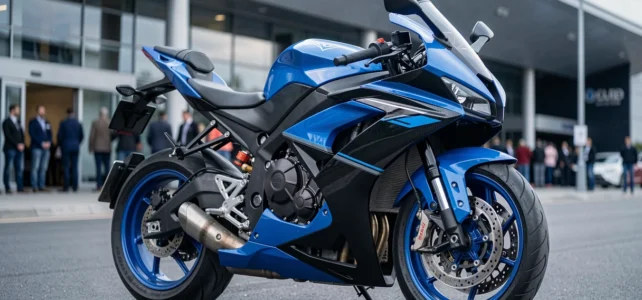
When you’ve been riding a R1 for years and Yamaha announces that it will no longer be road-legal in Europe, the question quickly arises: what to replace it with without losing the Supersport DNA of the Iwata manufacturer? The Yamaha R9 arrives precisely in this niche, with a positioning that does not seek to copy the R1 but to offer something different.
Three-cylinder engine, lightweight chassis, electronics calibrated for both road and track: let’s take a look at what we know concretely.
Yamaha R9 and the end of the road R1: what it means for European riders
The withdrawal of the road-legal R1 in the European Union, linked to Euro5+ standards, has left a gap in Yamaha’s lineup. The R7, accessible and efficient, does not meet the expectations of riders who want a sharper sportbike to tackle the track while being able to ride home on the road.
The R9 fills this space. It positions itself between the R7 and the R1 track, not as a simple replacement but as a transitional model designed to be usable on a daily basis. For those looking for a Yamaha supersport bike capable of handling a track day and a commute, it is the most direct answer in the catalog.
We also find the technical details of the new Yamaha R9 motorcycle in several sources that confirm this versatile orientation, far from the pure radicalism of a machine reserved for the track.
R9’s 890 cc CP3 engine: road behavior and track potential
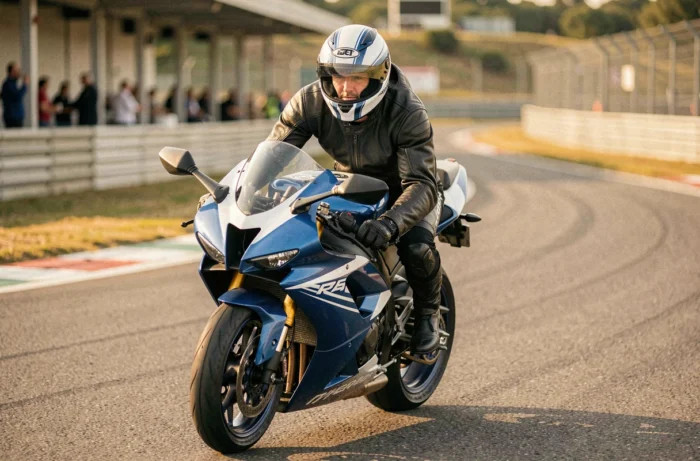
The 890 cc CP3 three-cylinder engine is not a new discovery. We know it from the MT-09, the Tracer 9 GT+, and the XSR900GP. In the R9, this engine retains its main characteristics with a claimed power of 119 horsepower.
What changes is the context. A three-cylinder in a supersport chassis provides torque available lower in the rev range than an equivalent four-cylinder. Coming out of a corner on the track, the response happens without waiting for the maximum power zone. On the road, this means fewer gear changes in tight sequences.
Initial feedback from the field converges on one point: the R9 is more usable than a traditional supersport. The engine character remains sporty, but you don’t need to ride at full throttle to enjoy it. Feedback varies on the level of vibrations at mid-revs, a point to check during an extended test.
Quick comparison with competing engines
Against the four-cylinder models in the segment (Kawasaki ZX-6R, for example), the CP3 operates in a different register. Fewer horses at the top, but a more linear torque curve and a contained weight. For mixed road-track use, this compromise benefits riders who do not always ride at full throttle.
Yamaha R9’s Deltabox chassis and weight: what we gain in agility
The R9’s aluminum Deltabox frame weighs less than 10 kg according to manufacturer data. It is the lightest ever produced by Yamaha for this type of structure. With a total weight claimed at 195 kg fully fueled, the power-to-weight ratio places the R9 in a very accessible category for riding.
In practical terms, during a track session, this translates to quick direction changes and a machine that does not tire the arms in chicanes. On the road, agility is felt from the first roundabouts.
- Lightweight aluminum Deltabox frame, inheriting Yamaha’s competition know-how
- Aerodynamic winglets at the front to keep the wheel on the ground during acceleration, with an option for an additional deflector
- Adjustable suspensions allowing the machine to be adapted to the rider’s profile (soft road or firm track)
- 14-liter fuel tank, sufficient for a track day without excessive refueling
The chassis-aero package directly benefits from the work done on the R1 Race. We find technical solutions derived from competition, adapted for less extreme but equally rigorous use in terms of precision.
Electronics and price of the R9: what to check before buying
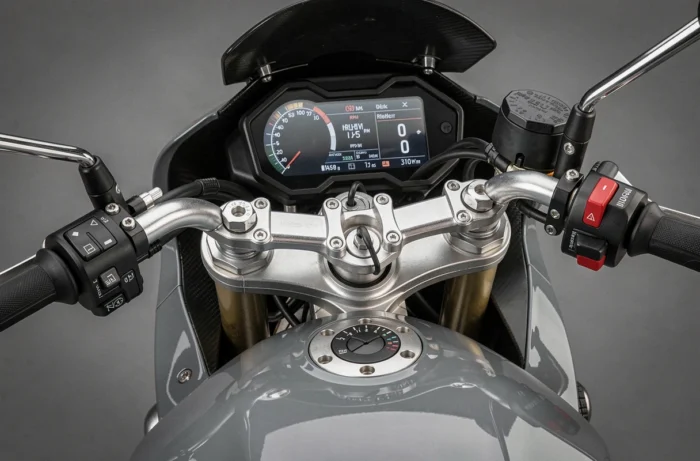
The onboard electronics cover the fundamentals expected on a modern sportbike. Traction control, riding modes, quickshifter: the R9 checks the boxes without falling into the excess of complex menus.
What interests us more is how these aids perform in real conditions. On a dry track, the traction control should know how to stay in the background while remaining present when pushing hard out of a corner. In the rain, it is the smoothness of the intervention that makes the difference between well-calibrated electronics and an aid that abruptly cuts power.
Pricing and positioning against the competition
The listed price for the R9 is around 13,999 euros. For this price, you get a machine that does not require heavy modifications to ride on the track. No mandatory suspension changes, no engine reprogramming necessary for the first sessions.
- Competitive price compared to four-cylinder supersport models in the segment
- Potentially lower maintenance costs thanks to the three-cylinder engine (fewer valves, maintenance intervals similar to the MT-09)
- Sport-touring tires compatible with both road and track without systematic changes
For a rider starting out in track days or looking for a versatile sportbike without breaking the bank on preparation, the R9 represents the most coherent entry in the Yamaha Supersport range in 2025.
Availability in dealerships was expected in May 2025. The offer of original accessories (saddlebags, protections, track kits) should follow quickly, as Yamaha is accustomed to structuring its options catalog from the launch. It remains to be seen how the used market will evolve in the following months, now that the road R1 is no longer in the catalog.