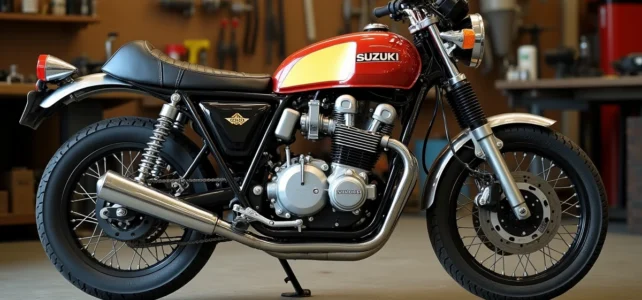
On a an exchange market parking lot, we come across a GT 750 that looks pristine: shiny chrome, original paint, reasonable mileage on the odometer. The seller assures that “everything works.” But with a water-cooled two-stroke motorcycle produced in the 1970s, the pitfalls are hidden where you don’t look at first glance.
The cooling system, crankshaft seals, and the internal condition of the cylinders: this is what separates a good deal from a financial pitfall.
Liquid cooling system: the first component to inspect on a GT 750
The Suzuki GT 750 was the first production motorcycle equipped with liquid cooling. This technical advancement, directly derived from competition, remains its most sensitive point fifty years later.
We start with the radiator. On a machine that has been stationary for a long time, the core corrodes from the inside. A partially clogged radiator is not visible from the outside, but the engine overheats abnormally as soon as you ride two-up or in hot weather. We check that the fan activates correctly and that the temperature gauge rises gradually, without jerks.
The original water hoses are made of rubber, and after several decades they harden, crack, or swell under pressure. A systematic replacement with new hoses (silicone or reinforced rubber) is part of the purchase budget, not optional maintenance. The clamps also deserve a look: period models rust and lose their tension.
To delve deeper into the reliability of the Suzuki GT 750 and its mechanical specifics, several guides detail the checks to perform before any purchase.
Crankshaft seals and two-stroke engine sealing
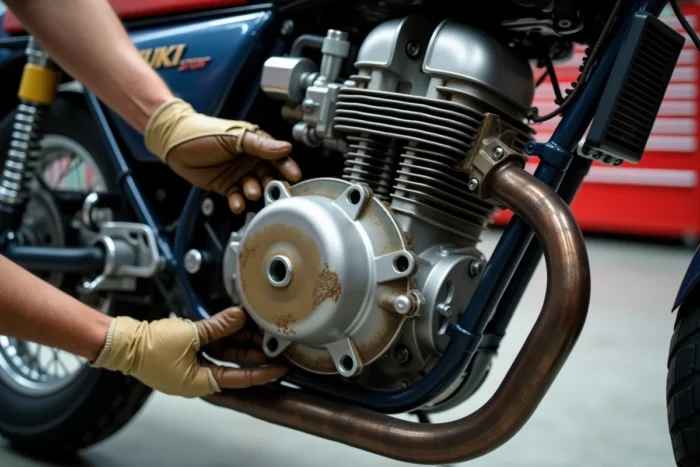
On a four-stroke engine, a slight oil leak dirties the garage. On a three-cylinder two-stroke, a faulty crankshaft seal compromises the carburation and lubrication. The air-fuel-oil mixture passes through the crankcase, and any air intake skews the mixture ratio of the affected cylinder.
The classic symptom: a cylinder that “leans out” (runs too lean) while the other two operate normally. When cold, a slight whistling can be heard at idle on the crankcase side. When hot, it’s the spark plug of the affected cylinder that turns abnormally white.
Replacing these seals involves a complete disassembly of the lower engine, a heavy and costly operation if entrusted to a specialist. Therefore, before purchasing, one should always ask if this work has been done recently. An invoice for this work is worth its weight in gold in a sales dossier.
Quick startup test
- Start cold and observe the exhaust smoke from each outlet: all three pipes should smoke evenly during warm-up
- Let it idle for several minutes and check that the RPM remains stable, without cyclical variations
- Accelerate firmly in second gear: a clear hesitation or misfire on one cylinder indicates a sealing or carburation issue
Braking and chassis: what ages unexpectedly
The early models of the GT 750 were equipped with a front drum brake, later replaced by one or two discs depending on the version. The type of braking directly conditions the road use of the machine. A model with a front drum remains usable for a leisurely ride but quickly shows its limits when riding two-up or on mountain roads.
On disc versions, we check the thickness of the discs (wear by visible grooves), the free movement of the calipers, and especially the condition of the master cylinder. A master cylinder seized by time gives a feeling of a soft or spongy lever, even after a careful bleed.
On the chassis side, the GT 750 is a heavy machine. The steering head bearings and swingarm bushings bear this weight over the miles. A simple test: motorcycle on the center stand, grasp the fork and push-pull along the axis. Any perceptible play indicates bearings that need replacing.
Tires and rear suspension
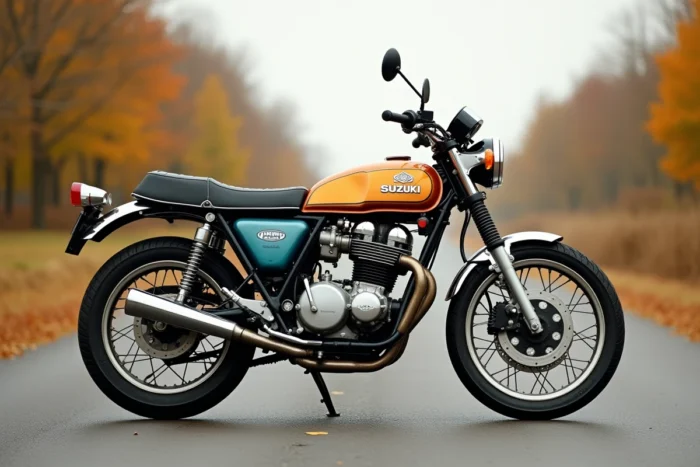
The period tires (when still mounted) should be replaced without discussion, even if they appear visually acceptable. Rubber hardens over time and loses all grip. The original rear shock absorbers are also often worn: the motorcycle “bottoms out” when riding two-up or on rough roads.
Collection registration and administrative constraints of the GT 750
In France, a GT 750 can be registered as a collection vehicle. This status requires a certificate of dating and characteristics (issued by the FFVE or the manufacturer), which confirms that the motorcycle has not undergone major modifications: non-compliant engine, modified chassis, or altered safety components.
For motorcycles manufactured after 1960, the collection technical inspection occurs every five years instead of three years for classic motorcycles. In practice, a GT 750 under collection registration is often better preserved and less modified. Feedback varies on this point, but a collection machine that is ridden little accumulates problems related to prolonged parking: dry seals, clogged circuits, oxidized wiring.
Before purchasing, we check that the registration document matches the frame number and engine number. On GT 750s, an exchanged engine without declaration seriously complicates the registration process.
Realistic maintenance budget for regular riding
Running a GT 750 daily or on regular outings requires a higher wear parts budget than that of a contemporary Japanese four-stroke motorcycle. Two-stroke oil is consumed continuously (that’s the principle), spark plugs foul more quickly, and the rings wear out more than an equivalent four-stroke engine.
Specific parts (water pump seals, thermostat, rings to original specifications) can still be found through the network of vintage motorcycle specialists and some international suppliers. Availability remains decent for now, but stocking a set of critical parts in advance is a reasonable precaution.
The GT 750 is not a fragile motorcycle. It is a solid touring machine, designed to cover miles two-up with luggage. Its water-cooled three-cylinder two-stroke engine remains a unique mechanism in the landscape of Japanese collectible motorcycles. Buying it with knowledge of the facts, with the right checks performed, ensures enjoying this machine without unpleasant surprises on the roadside.