
Sunbathing in your garden may seem innocuous, much more so than on a wind-swept beach. This perception leads many people to neglect their sun protection during mundane activities: reading on a deck chair, having lunch on the terrace, gardening late in the morning. Dermatologists remind us that UV rays reach the skin with the same intensity, whether you are on the sand or on your lawn.
The Skin Cancer Foundation states unequivocally: there is no such thing as risk-free tanning. The familiar setting of the garden does not change the nature of the ultraviolet radiation received by the skin. Starting from this observation allows for the adoption of concrete reflexes, adapted to daily and domestic sun use.
Garden exposure: why the risk is underestimated compared to the beach
On a beach, most people think to bring sunscreen. In a garden, this reflex often disappears. An article from Doctissimo highlights that the terrace, cycling, or gardening are part of everyday moments when the French still forget to protect themselves from the sun. Exposure is sometimes longer than at the beach because it happens without awareness of the time spent.
Several factors worsen the situation. A meal outside with friends can last two to three hours in the middle of the day. DIY projects or maintaining the vegetable garden distract attention from UVs. And unlike at the beach, you don’t go swimming to cool off, which masks the sensation of heat and delays the perception of sunburn.
Finding tips for tanning in your garden helps structure your habits, but the first reflex remains to realize that the garden offers no natural protection against UVs, unless you actively create shade.
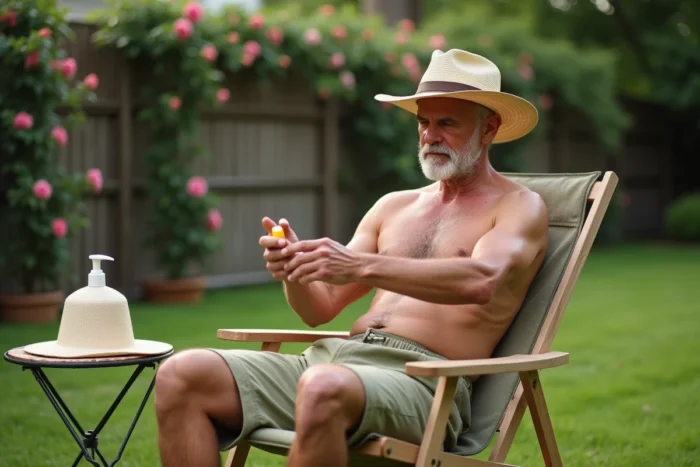
Sun protection in the garden: sunscreen is no longer enough as the main shield
Recent public health recommendations have made a notable shift. Sunscreen is no longer presented as a permission to stay in the sun, but as a complement. The first line of defense relies on physical protections.
- Covering clothing (light long sleeves, loose pants) blocks a significant portion of UVs, much more than poorly applied or unrenewed sunscreen.
- A wide-brimmed hat protects the face, ears, and neck, three areas particularly exposed during gardening or reading outside.
- UV-filtering sunglasses protect the eyes and the surrounding area, a zone where the skin is very thin and vulnerable.
- Shade (parasol, pergola, tree with dense foliage) acts as a natural filter. It does not block all rays, but significantly reduces direct exposure.
Sunscreen acts as a complement on uncovered areas. It must be applied in sufficient quantity and reapplied regularly, even when not swimming. Sweat from gardening or ambient heat degrades protection as quickly as a sea bath.
Shade in the garden: a filter, not a total shield
Staying under a pergola or parasol does not mean being completely protected. Shade reduces the intensity of UVs without completely eliminating them. Rays reflect off light surfaces (paving, white walls, pool water) and reach the skin indirectly. Wearing a hat and applying sunscreen to exposed areas remains relevant, even in the shade.
Time slots and duration of exposure: adapting habits in the garden
The Skin Cancer Foundation recommends considering shade as a refuge between 10 AM and 4 PM. This time frame corresponds to when UV radiation is most intense. For the garden, this means planning outdoor activities.
Early in the morning (before 10 AM) or late in the afternoon (after 4 PM), exposure is less aggressive. These time slots allow for enjoying the sun with reduced risk, provided that you do not abandon all protection. Mowing the lawn at 9 AM rather than 1 PM significantly changes the level of UV received.
Between 10 AM and 4 PM, it is better to retreat to a shaded area. Having lunch under a pergola or a large tree allows you to stay outside without suffering direct radiation. The gradual tanning obtained during these moderate time slots generally lasts longer than a quick tan acquired at noon, often followed by peeling.
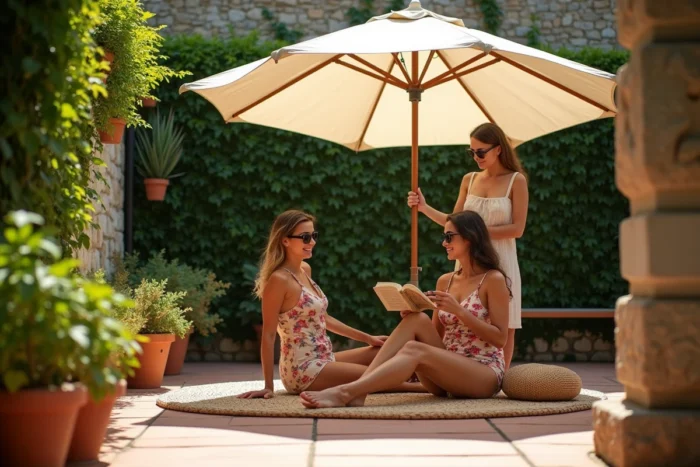
Skin hydration and diet: what prolongs a tan without forcing it
Well-hydrated skin retains its tan better. After each exposure, even short, applying a moisturizing treatment on the body limits skin dryness and slows down the cellular turnover that causes peeling.
Internal hydration is as important as external. Regularly drinking water while spending time in the garden compensates for water loss due to heat and helps the skin maintain its suppleness. Diet also plays a role: fruits and vegetables rich in beta-carotene (carrots, apricots, mangoes, red peppers) help prepare the skin, without replacing sun protection.
Gentle exfoliation before exposure
A light scrub, done one or two days before exposure, removes dead surface cells. The tan then settles on more even skin. An even tan lasts better than a tan on dry and rough skin. Exfoliation should not be aggressive: a gentle scrub is sufficient. Scrubbing too hard weakens the skin barrier and makes it more vulnerable to UVs.
Persistent myths about tanning in the garden
Several misconceptions still circulate. One of them: using a high SPF cream would prevent tanning. In reality, a high SPF slows down tanning but does not block it. The result is more gradual, more even, and the skin suffers less damage.
Another persistent myth: tanning at noon would be more effective. The radiation is indeed more intense, but the risk of burning increases proportionally. The UVs responsible for tanning (UVA) are present throughout the day, not just at zenith.
Not feeling heat on the skin also does not mean that UVs are weak. On cloudy or windy days, ultraviolet radiation penetrates clouds and the breeze masks the sensation of burning. This trap is common in the garden, where one feels protected by the apparent coolness.
The garden remains a pleasant living space to enjoy the summer sun. But the comfort it provides should not make one forget that the skin does not distinguish between a beach deck chair and a lounge chair on the lawn. The same UVs, the same cream, the same clothing, the same vigilance regarding timing: this triptych makes tanning more durable and the skin less damaged over the summers.