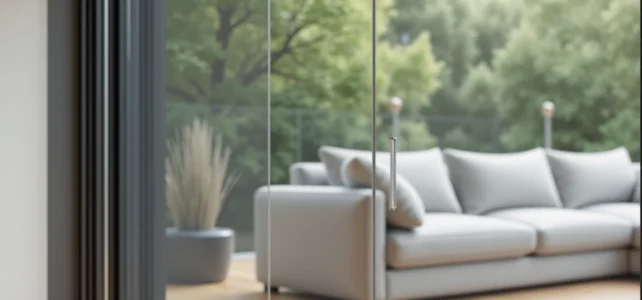
Large sliding glass doors, often measuring 300 x 220 cm, present a concrete problem as the first warm days arrive: opening them for ventilation means letting in mosquitoes, flies, and wasps. The sliding mosquito net on a rail addresses this constraint, but choosing a model suitable for these dimensions requires understanding some technical points that product sheets do not always detail.
Sliding mosquito net on a rail: what the width of 300 cm really changes
On a standard window, most mosquito net systems work without difficulty. With a three-meter-wide sliding door, the mechanical constraints change. The weight of the fabric increases, the rigidity of the frame becomes a determining factor, and the rail must support wider panels without the sliding mechanism getting stuck after a few months of use.
An extruded aluminum frame offers better performance than a PVC profile at these widths. PVC tends to flex under the heat and the combined weight of the fabric and frame, causing friction in the rail. Aluminum remains stable even over spans of three meters, provided that the thickness of the profile is sufficient.
The configuration with two sliding panels is the most common for this format. Each panel covers about half of the opening, which limits the effort required for operation and reduces the overhang. Some manufacturers offer single-panel versions, but feedback from the field varies on the durability of this option beyond a few seasons.
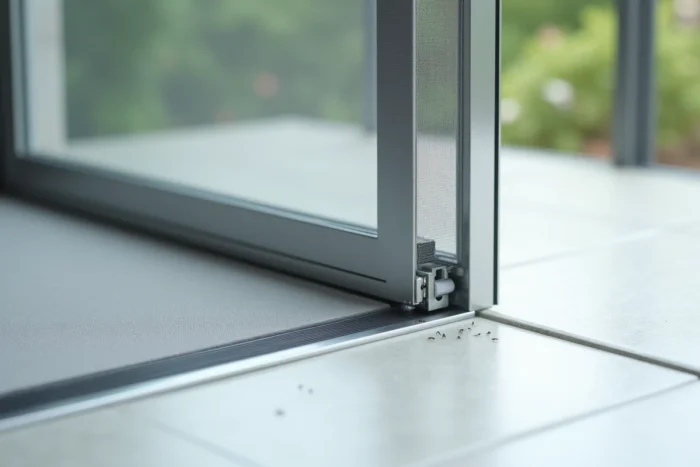
Installing a sliding mosquito net for a 300 x 220 sliding door also requires checking the depth of the frame. The bottom rail must fit into the available space without obstructing the threshold of the existing sliding door, or it risks creating a bump on the floor.
Fiberglass or polyester fabric: mesh quality and UV resistance
The choice of fabric determines both protection against insects and visibility to the outside. Two materials dominate the market: PVC-coated fiberglass and polyester.
Fiberglass offers better UV resistance over time. It retains its flexibility and color longer, which is important for a south or west-facing sliding door. Polyester is cheaper, but it tends to stiffen and lose its black hue (the most common) after a few summers of direct exposure.
The black color of the fabric is not an arbitrary aesthetic choice. It reduces glare and improves visual transparency from the inside. A gray or white fabric creates a more noticeable veil, especially over large surfaces like a three-meter-wide opening.
- PVC-coated fiberglass: good UV resistance, lasting flexibility, slightly higher price
- Standard polyester: affordable price, gradual stiffening, needs to be replaced more frequently
- “Pet-resistant” (reinforced) fabric: denser mesh to withstand cat claws, but slightly reduces airflow
This last point aligns with a recent trend: sliding mosquito nets designed for the safety of cats and young children. Specialized installers offer reinforced fabrics and lockable frames that prevent an animal or child from pushing the panel and accessing the outside.
Natural ventilation and an alternative to air conditioning: a growing practice
The primary function of a mosquito net remains protection against insects. Its role in thermal management of the home is less often documented, but it is becoming more important with the increasing number of heat waves.
The principle is simple: open the sliding door in the evening and at night to expel the heat accumulated during the day while keeping the mosquito net closed. This natural nighttime ventilation reduces the need for air conditioning without exposing the interior to pests. On an opening of 300 x 220 cm, the airflow passing through the fabric is more than sufficient to cool a living room.
Combining it with external sun protection (awnings, adjustable sunshades) enhances the effectiveness of this approach. The awning blocks direct sunlight during the day, and the mosquito net takes over at night. This tandem avoids the systematic use of air conditioning, directly impacting the household’s electricity consumption.
Surface-mounted or recessed installation: compatibility with aluminum sliding doors
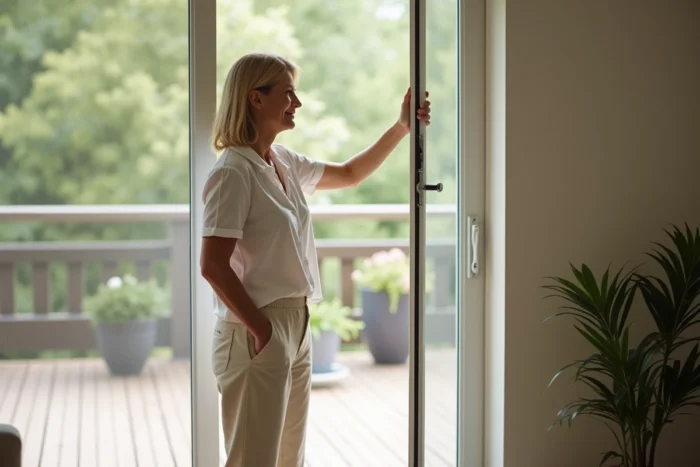
There are two installation methods for a sliding mosquito net on a large sliding door. Recessed installation (inside the frame) offers a discreet finish and protects the rail from the elements. Surface-mounted installation (on the outer or inner face of the wall) is suitable when the depth of the frame is insufficient.
On aluminum sliding doors with pocket systems, recessed installation is rarely possible: the free space in the frame is occupied by the folding mechanism of the panel. Surface-mounted installation on the outside then becomes the only option, with sealing constraints at the bottom rail.
- Recessed installation: aesthetic finish, protected rail, requires sufficient frame depth
- Interior surface-mounted installation: common compromise, visible rail but accessible for maintenance
- Exterior surface-mounted installation: necessary on pocket doors, be cautious of water accumulation in the rail
The flush bottom rail is a comfort criterion often underestimated. A rail that protrudes too much creates an obstacle to passage, particularly troublesome for people with reduced mobility or families with young children. Some systems integrate a rail that can be embedded in the existing threshold, but their installation requires precise cutting.
Sliding or pleated mosquito net for sliding doors: two different logics
The pleated mosquito net (accordion-style fabric) is gaining visibility in the large opening segment. Its main argument: it folds down to a few centimeters and completely frees the passage when not in use.
The sliding mosquito net, on the other hand, keeps its panels permanently in the rail. The free passage is reduced by the thickness of the side frames. In return, the sliding version handles frequent use better over the long term. Pleated fabrics, which are mechanically more fragile, can deform if a child or pet presses against them.
Manufacturers and carpenters are increasingly promoting pleated mosquito nets as a high-end decorative element, with slim frames and colors matching the woodwork. This aesthetic positioning is justified on contemporary sliding doors with large glass panels, where a thick frame would distort the architectural line.
The choice between the two systems primarily depends on the frequency of daily use and the profile of the occupants. For a sliding door leading to a terrace used several times a day, the sliding version remains the most robust choice. For a less frequently used opening where aesthetics take precedence, the pleated option deserves consideration.