
The Scholl insole and the Birkenstock footbed are based on distinct biomechanical philosophies. Confusing the two is akin to comparing an active foot support device with a passive molding system. Here, we detail the technical criteria that truly guide the choice between these two brands for everyday use.
Scholl Insole vs. Birkenstock Footbed: Two Biomechanical Approaches
Scholl builds its models around a preformed insole with immediate orthopedic support. From the first wear, the arch is supported, and the heel is held in a rigid cup. This approach is suitable for individuals who need postural correction without a break-in period.
Birkenstock takes the opposite approach. Its cork and latex footbed gradually molds under the weight of the wearer to fit the foot’s imprint. Comfort increases over several weeks. We observe that this system promotes a more natural support in the long term, but it requires an adjustment period that many first-time buyers underestimate.
To choose between Scholl and Birkenstock shoes, the initial question is therefore not aesthetic: it is the speed of expected support that makes the difference.
Scholl Comfort for Standing Professions: A Medical Positioning
Scholl explicitly targets professions that require prolonged standing: healthcare personnel, retailers, and restaurant workers. The brand’s professional ranges incorporate slip-resistant materials, washable insoles, and a reinforced midfoot support right out of the box.
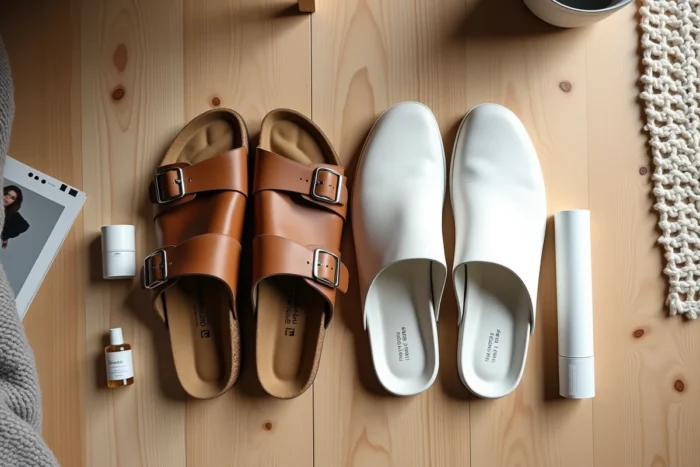
This positioning has a direct consequence on the construction of the footwear. Scholl models favor semi-closed or closed uppers, with a more pronounced heel counter than Birkenstock. The foot moves less within the shoe, which reduces muscle fatigue during eight-hour days or longer.
Birkenstock, on the other hand, has shifted towards a versatile and lifestyle use. The Boston model, for example, is found in both casual urban settings and indoors. Lateral support remains adequate thanks to adjustable straps, but the open design of many models (Arizona, Gizeh) is not suitable for intensive professional use where the foot needs to remain perfectly stabilized.
Compatibility with Custom Orthotics
A criterion rarely addressed in consumer comparisons: the possibility of removing the original insole to replace it with a custom orthotic prescribed by a podiatrist.
- With Birkenstock, the cork footbed is glued to the bottom of the shoe in most models. Removing it alters the structure and nullifies the very principle of gradual molding. Adding an orthotic on top creates a lift that changes the angle of the ankle.
- With Scholl, several ranges offer a removable insole, making it easier to replace with a custom device. This is a clear advantage for wearers suffering from plantar fasciitis, bunions, or metatarsalgia.
- For use with orthotics, we recommend systematically checking the depth of the footwear. A shoe that is too snug with an orthotic compresses the top of the foot and causes dorsal pressure points.
Birkenstock Cork and Durability of Support
Birkenstock cork compresses over time. After several months of daily use, arch support diminishes. Resoling is possible at an authorized cobbler, but the cost represents a significant portion of the initial purchase price. Scholl, with its synthetic insoles, loses less height over time but does not offer the molded comfort that cork provides at mid-life of the product.
Birkenstock Sandals and Scholl Shoes: Price Range and Quality Trade-off
Existing content rarely compares prices head-on. Natural leather Birkenstock sandals are priced significantly higher than entry-level and mid-range Scholl models. The gap widens further for editions in oiled leather or suede.
The comfort-to-euro ratio depends on the intensity of use. For occasional use (weekends, vacations), Birkenstock justifies its price through the longevity of cork and the quality of leather. For daily professional use with frequent replacements, Scholl offers a more reasonable operating cost.
- Birkenstock Arizona in smooth leather: high end of the range, long lifespan if cork is maintained
- Scholl professional range: moderate price, replaceable insole, suitable for demanding environments
- Birkenstock Boston in suede: fashion and comfort investment, but sensitive to moisture and stains
- Scholl wooden mules: retro style segment, correct foot support but less seasonal versatility

Foot Morphology and Width: The Forgotten Criterion
Birkenstock offers two standardized widths (regular and narrow) on most of its models. This is a real advantage for wide or narrow feet, two morphologies poorly served by most sandal brands.
Scholl does not standardize this dual width. The footwear is generally calibrated to a medium width. Narrow feet float, while wide feet are compressed. Checking the availability of half sizes and alternative widths before purchase avoids many returns.
For feet with a tendency to pronate (arch collapsing inward), the Birkenstock footbed with its lateral edge offers appreciable passive guidance. Scholl compensates more with the rigidity of its insole, which limits the range of pronation without actively correcting it.
The final choice between Scholl and Birkenstock is not merely a brand preference. It depends on foot type, daily wear duration, and the need or not to integrate an orthotic insole. A wearer in prolonged standing with an orthotic will find more flexibility with Scholl. An occasional walker seeking gradual and lasting comfort will favor Birkenstock cork.