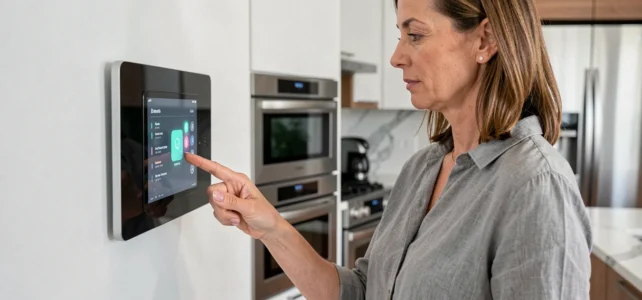
Home automation in 2026 no longer resembles what it was three years ago. The European residential market has shifted towards a common protocol, AI is being integrated directly into sensors, and the European regulatory framework imposes new obligations on manufacturers. These changes are altering the way a household chooses, installs, and evolves its connected devices.
Matter Protocol and Home Automation: What Changes for Equipment Purchases
Until recently, buying a connected thermostat or a smart bulb meant checking compatibility with the existing ecosystem (Zigbee, Z-Wave, proprietary Wi-Fi). This interoperability issue hindered adoption and locked users into a single manufacturer.
Since 2025-2026, major residential manufacturers like Legrand, Schneider, Philips, Eve, or Aqara have shifted towards products natively compatible with Matter. Some professional guides now recommend Matter as the default protocol for residential use. The change is tangible: a Matter device works with Apple Home, Google Home, Amazon Alexa, or Samsung SmartThings without needing an additional gateway.
For an individual, this means three things. First: the resale of equipment becomes possible, as a Matter device retains its value regardless of the ecosystem of the next buyer. Second: installation is simplified, with pairing via a standardized QR code. Third: the longevity of devices is no longer tied to the survival of a brand. If a manufacturer disappears, the product remains controllable by any compatible platform.
Industry professionals, such as Domotica, are supporting this transition by offering solutions already aligned with this open standard.

Embedded AI in Connected Devices: From Control to Autonomous Operation
In 2026, home automation is no longer just about controlling devices from a smartphone. The underlying trend focuses on proactive connected objects equipped with embedded AI, capable of acting without user prompting.
A traditional thermostat follows a schedule set by the user. An AI-embedded thermostat analyzes presence patterns, local weather, and the thermal inertia of the building to adjust heating without intervention. The difference lies in local data processing, known as edge computing: calculations are performed within the device, not on a remote server.
This local architecture addresses a growing concern among French households: privacy. When a presence sensor processes its data locally, no information is sent to the cloud. Field reports vary on this point, as some manufacturers continue to combine local processing with partial data uploads to improve their algorithms.
Consequences for Energy Consumption
Continuous optimization by local AI produces measurable effects on heating bills. Instead of applying fixed scenarios, the system adapts its response in real-time. A connected shutter can close automatically when the solar sensor detects a heat spike, without the occupant having programmed this action.
The smart home shifts from a reactive mode to a proactive mode. This evolution also relies on the maturity of low-power networks (LoRaWAN, NB-IoT) and 5G, which enable distant sensors (garden, garage, outbuildings) to communicate reliably with the central system.
AI Act Regulation and Connected Homes: Obligations to Know
The European regulation on artificial intelligence (AI Act) imposes new obligations on manufacturers of connected devices. Since August 2026, new provisions have come into effect. The CNIL has been designated as the supervisory authority in France, with sanctioning power.
For an individual equipped with home automation, the effects are indirect but real:
- Manufacturers must document the functioning of the AI embedded in their products, improving transparency about what a connected device actually does with the collected data.
- High-risk systems (certain home surveillance cameras with facial recognition) are subject to enhanced compliance requirements.
- Sanctions can reach significant amounts, prompting manufacturers to review their data collection practices.
This regulation creates a regulatory pressure favorable to local and transparent solutions. Home automation systems that process data using edge computing, without sending it to third-party servers, are mechanically advantaged in this context.
Real Estate Value and Connected Homes: An Uncertain Resale Argument
Some real estate professionals argue that home automation increases the resale value of a property. The impact depends on the type of installation, its age, and especially its compatibility with current standards.
An aging proprietary home automation system can even become a barrier to sale: the buyer anticipates the cost of replacement. In contrast, a recent Matter installation reassures because it remains usable by any ecosystem. The open protocol transforms a potentially obsolete device into a sustainable infrastructure.
Factors Influencing Property Valuation
Elements that seem to positively influence the valuation of a connected home are energy-saving devices (smart thermostat, automated heating and lighting management) rather than pure comfort gadgets. A buyer perceives value in a system that reduces their expenses, less so in a connected speaker integrated into the ceiling.
The smart home market continues to structure itself. The convergence between the Matter protocol, embedded AI, and the European regulatory framework outlines a landscape where today’s technological choices determine the compatibility and value of the installation for years to come. The cost of equipment compliant with these new standards remains a key factor for their large-scale adoption.