
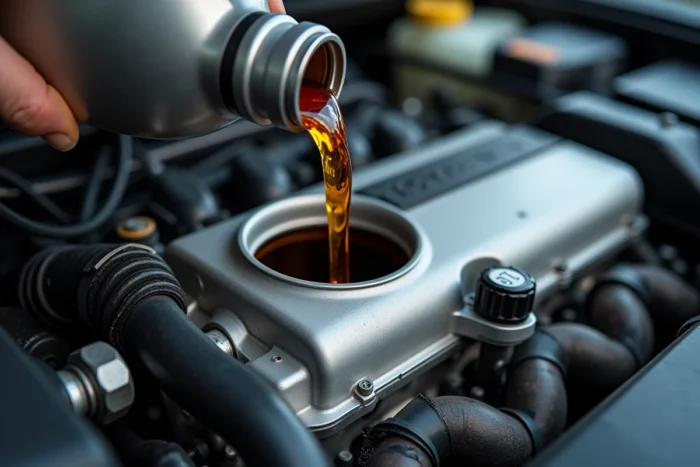
On a recent turbo gasoline engine, pouring a 5W50 oil instead of the 5W30 recommended by the manufacturer may seem trivial. A thicker oil at high temperatures should, in theory, better protect internal components. However, modern engines are designed around precise viscosities, and deviating from these has measurable consequences.
5W50 Oil and LSPI Pre-Ignition in Turbo Direct Injection Engines
Downsized gasoline engines (small displacement, turbocharger, direct injection) dominate the current automotive fleet. These engines are exposed to a phenomenon called LSPI (Low Speed Pre-Ignition): a low-speed pre-ignition that causes destructive pressure spikes in the combustion chamber.
The formulation of the oil plays a direct role in triggering LSPI. Detergents, the level of additives, and viscosity influence the likelihood of occurrence. Manufacturers like GM have developed targeted specifications, notably the dexos1 Gen 3 standard, which mandates oils in 0W20, 5W20, or 5W30 with optimized formulations to reduce this risk.
When understanding the effects of 5W50 motor oil on these architectures, the conclusion is clear: a thicker oil that does not comply with these recent specifications can increase the risk of LSPI, or at the very least, fail to benefit from the optimizations intended for these engines. This issue is documented by industry standardization bodies, not limited to a theoretical forum debate.
5W50 Viscosity and ACEA Standards: Why the Grade is Not Enough
The number 50 in “5W50” indicates the viscosity at high temperature. This grade was designed for engines subjected to extreme thermal stress: competition, track use, older engines with wider machining tolerances.
Modern engines are calibrated for fluid oils. The gaps between piston and cylinder are measured in microns. A oil that is too thick circulates more slowly in these narrow passages, which can reduce lubrication at startup and increase fuel consumption due to internal friction.
What the Manufacturer Standards Say
ACEA standards (European Automobile Manufacturers Association) classify oils according to engine test sequences. Recent categories target very low viscosity oils to meet emissions and energy efficiency requirements. A 5W50 simply does not fit into these categories.
API specifications (American Petroleum Institute) follow the same trend. The most recent standards adopted by the majority of Japanese and American manufacturers effectively exclude grades higher than 5W30 for recent gasoline engines.
- 5W50 oils do not meet the latest ACEA standards required by most European manufacturers for recent models
- GM’s dexos1 Gen 3 specification explicitly targets grades 0W20 to 5W30 to limit LSPI
- Current API and ILSAC standards do not cover viscosities like 5W50 for modern gasoline engines
Older Engines and Sports Use: Cases Where 5W50 Remains Relevant
It would be a mistake to condemn 5W50 outright. This oil has legitimate applications, but they are becoming rarer as the automotive fleet renews.
High Mileage or Older Generation Engines
On an engine from the 1990s or 2000s with more generous machining tolerances, a 5W50 compensates for the natural wear of components. The thicker oil film maintains proper pressure in engines where the gaps have widened over time. For an older high-mileage engine, 5W50 remains a defensible choice.
Track Use and Engine Preparation
In competition or on the track, oil temperatures regularly exceed normal operating thresholds. The grade 50 at high temperatures then offers a safety margin that fluid oils do not guarantee. Feedback varies on this point depending on the type of engine and level of preparation, but the consensus among preparers remains favorable to 5W50, or even 10W60, for these specific uses.
5W50 Motor Oil on Modern Vehicles: The Concrete Risks to Know
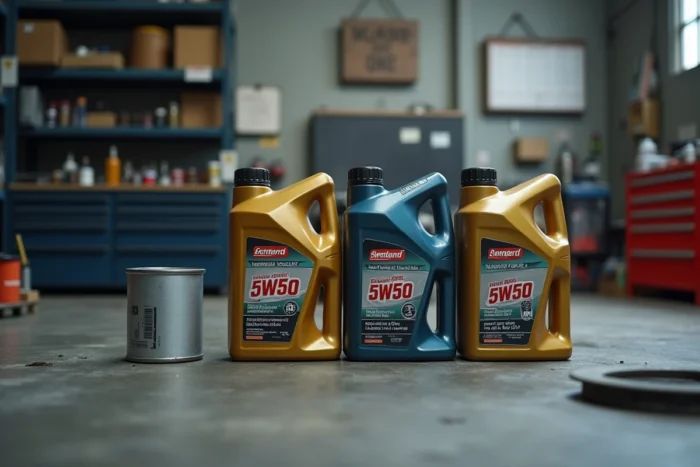
Using a 5W50 on an engine calibrated for 5W30 or a more fluid oil does not cause immediate failure. The damage is gradual and often invisible until the technical inspection or breakdown.
- Increased fuel consumption: the engine works harder to move a more viscous oil, resulting in a measurable increase at the pump
- Accelerated clogging of the particulate filter (DPF) and catalyst: an out-of-spec oil generates combustion residues different from those intended by the pollution control system
- Loss of manufacturer warranty: if the maintenance booklet specifies a standard (ACEA C3, dexos2, etc.) and the oil used does not comply, the manufacturer may refuse to cover an engine failure
- Increased risk of LSPI on turbo direct injection gasoline engines, as documented by industry standardization bodies
The classic trap comes from automotive forums where 5W50 is recommended indiscriminately across engine types. A good quality synthetic 5W50 oil is not “bad” in itself. It is simply unsuitable for the majority of vehicles produced in the last decade.
Before choosing a motor oil grade, the most reliable approach remains to consult the vehicle’s maintenance booklet or the manufacturer’s technical sheet. For modern engines, this almost systematically means an oil in 0W20, 5W20, or 5W30, with a specific ACEA or API standard to adhere to.