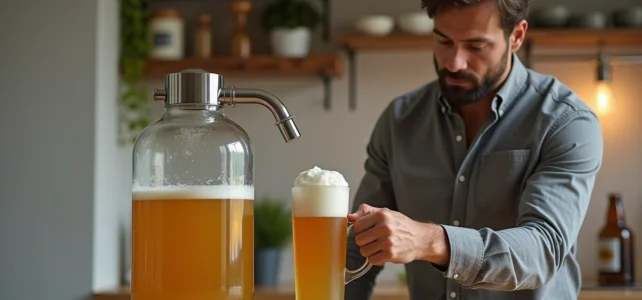
The 5 L panaché keg compatible with beer machines remains a misunderstood format, often reduced to a summer gadget. However, the product meets a specific technical constraint: maintaining a stable beer/lemonade ratio under pressure, from the first to the last glass, without loss of carbonation.
Carbonation and beer-lemonade ratio: what pressure changes in a panaché keg
A panaché served by hand loses its carbonation within minutes. The beer-lemonade mix, by nature less stable than beer alone, undergoes accelerated decarbonation as soon as the dissolved CO₂ comes into contact with ambient air.
In a pressurized 5 L keg, the carbonation remains homogeneous as long as the keg is not punctured. The internal pressure system (CO₂ cartridge or residual pressure depending on the model) keeps the gas in solution. The beer/lemonade ratio, set at the brewery during conditioning, does not degrade over the course of serving.
We observe that this stability has a direct effect on waste: a panaché that loses its bubbles ends up poured down the sink. With a pressurized keg, each glass retains the same level of fizziness, eliminating this common waste during the evening. Choosing the 5L panaché keg for beer machines means locking in the quality of service throughout the event.
Compatibility of 5 L panaché kegs with home beer machines
Not all 5 L kegs are created equal mechanically. Compatibility depends on the type of dip tube and the pressurization system, not just the diameter of the keg.
BeerTender and PerfectDraft systems: two different logics
BeerTender machines use a dip tube integrated into the keg, with natural residual pressure. PerfectDraft kegs operate with an external pressure mechanism via a compressor built into the machine. A panaché keg designed for one will not work on the other without adaptation.
Standalone kegs (without a machine) constitute a third category. They have their own tap and pressure system. Kegging is done directly from the fermentation tank, ensuring natural carbonation without artificial gas injection.
- BeerTender kegs: internal dip tube, residual pressure, compatible with Krups/SEB BeerTender machines
- PerfectDraft kegs: external pressure via compressor, compatible only with Philips PerfectDraft machines
- Standalone kegs: integrated tap, no machine needed, served by gravity and internal pressure
Before any purchase, we recommend checking the compatibility label on the keg itself. A generic 5 L panaché keg without system indication may not fit any home tap.
5 L panaché keg and anti-waste logic: beyond marketing
The zero waste argument relies on three concrete mechanisms, not on a vague promise. The 5 L format combines them all.
The first is preservation. An unpunctured keg can be stored for several weeks at a stable temperature. Once opened, most manufacturers announce a consumption window of a few days, compared to a few hours for a panaché prepared in a pitcher.
The second concerns dosing. Each pull at the tap delivers a controlled amount. No open bottle lying around, no warm leftover glass abandoned on the table. On-demand service mechanically reduces unused volumes.
The third touches on the logistics of containers. A 5 L keg replaces about fourteen 33 cl bottles. Less glass, fewer caps, less packaging cardboard. “Bottom filling” systems (like Beer Up for BeerTender kegs) push this logic even further by allowing the container to be reused.
Deposit and reuse: a framework that is progressing in Europe
The deposit logic on beverage containers is gradually being structured in Europe. Germany already has a very advanced in-store return system for these types of formats. In France, regulations are evolving, and reusable kegs are part of this underlying trend.
For breweries, offering a 5 L panaché keg is not just a sales format: it is a lever for customer loyalty and stock rotation. The format encourages regular repurchase rather than one-off purchases of packs of bottles.
Serving temperature and storage of panaché in a 5 L keg
Panaché is more sensitive to temperature than beer alone. The lemonade fraction contains sugars that alter the perception of freshness and fizziness. Serving a panaché too warm enhances the sweetness and suppresses the carbonation.
Most home beer machines regulate the temperature between 2 and 4 °C. This range is suitable for blonde beers but slightly low for a panaché. We recommend taking the keg out of the machine five to ten minutes before serving so that the lemonade better expresses its citrus aromas.
Storage before installation follows the same rules as for a classic beer keg: upright position, away from light, in a cool but not refrigerated place. A keg stored upright prevents any sediment from settling against the dip tube.
5 L panaché keg or homemade panaché: which format for which use
Homemade panaché retains an advantage: the freedom of dosing. Some prefer a 60/40 beer-lemonade ratio, others a strict 50/50. The keg imposes the ratio chosen by the brewer.
In return, the keg provides consistency. Each glass is identical to the previous one. For an evening with more than six guests, this consistency simplifies service and avoids mixing approximations that generate unusable leftovers.
The 5 L keg finds its best use between eight and fifteen people, where the volume is sufficient for the evening without excess the next day. Below six guests, the bottle format remains more flexible. Beyond twenty, a larger keg (like a 20 L professional type) takes over.
The choice of format therefore depends less on taste than on group size and tolerance for waste. The 5 L keg occupies precisely the niche where bottles generate too much waste and where a professional keg would be oversized.