
The profession of community pharmacist is based on a precise technical foundation: dispensing, checking for drug interactions, stock management, and monitoring adherence. Each task requires time, and each error has a direct clinical or economic cost. The solutions that support these professionals on a daily basis are no longer just digital gadgets, but an infrastructure that has become essential for the quality of care provided at the counter.
Pharmaceutical telecare and expanded vaccinations: an underutilized regulatory framework
Since decree no. 2023-736 of August 8, 2023, and the order of December 4, 2024, community pharmacists can prescribe and administer all vaccines in the vaccination schedule. This expansion of scope is accompanied by a digital component: pharmaceutical telecare now allows for follow-up consultations, remote medication reviews, or support for patients on anticoagulants.
The technical conditions are strict. The software used must integrate encrypted video transmission, strong authentication via CPS or e-CPS card, complete traceability in the patient file, and automatic updates to Mon espace santé.
The gap between this open regulatory framework and the reality on the ground remains significant. According to a study by UPGF based on GERS data, in 2026, only 34% of pharmacies practice teleconsultation and 41% conduct pharmaceutical consultations, while nearly all perform vaccinations and TROD. Professionals looking to structure these new missions can find suitable resources on the Pharmalog website for professionals, particularly to coordinate daily logistics and regulatory requirements.
Pharmacy management software: what distinguishes a structuring tool from a simple LGO
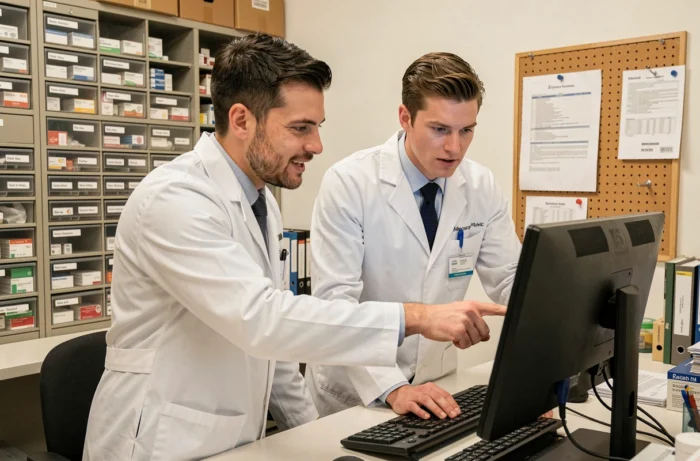
Pharmacy management software (LGO) handles dispensing, billing, and stock management. That’s the basics. What separates a merely functional tool from a structuring solution lies in three additional capabilities.
- Predictive stock analysis: instead of managing stockouts after the fact, some LGOs cross-reference sales history, seasonality, and wholesaler alerts to anticipate needs seven to fourteen days in advance. A pharmacist who adopted this type of module (documented case with Winpharma using winAutopilote) reduced their stock by 35,000 euros and freed up to three hours a day for their team.
- Ségur compliance and HDS hosting: since the mandatory e-prescription in December 2024, all LGOs must comply with interoperability and health data security standards. Non-compliant software exposes the pharmacy to concrete legal and operational risks.
- Integration of health services (TROD, vaccination, consultations) directly into the workflow, without double entry or manual export to a third-party tool.
Choosing an LGO is not just a price comparison. It determines the team’s ability to absorb new missions without extending their workdays.
Patient data management and care coordination in pharmacies
Pharmacies generate a considerable volume of data every day: prescriptions, TROD results, medication reviews, dispensing histories. The challenge lies not in collection, but in the secure circulation of this data among healthcare professionals.
Mon espace santé, the shared medical record (DMP), and secure health messaging form the foundation of this coordination. A pharmacist who systematically updates the DMP after a pharmaceutical consultation or a shared medication review makes the information accessible to the treating physician without delay.
Traceability and serialization of medications
The European directive on falsified medicines requires a unit verification of each box at dispensing. Serialization solutions integrated into the LGO automate this control. Without this component, the pharmacist must manually scan each product against an external database, which increases dispensing time.
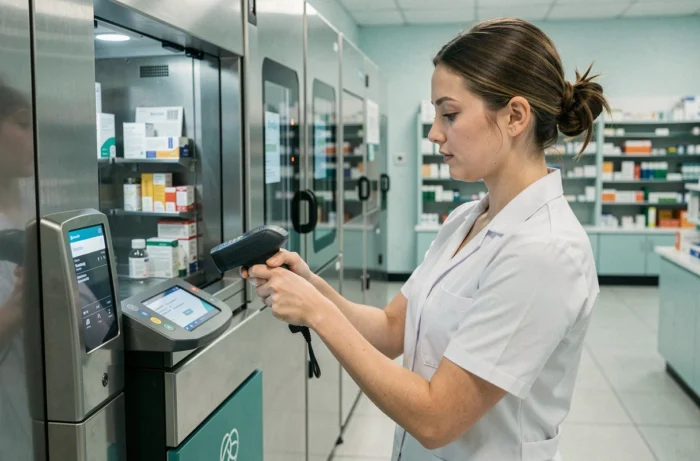
Automating traceability reduces the risk of error without slowing down the counter. Dispensing robots go further: they store, sort, and deliver boxes on demand, freeing the pharmacist for counseling and new clinical missions.
New public health missions: profitability and deployment conditions
The pharmaceutical agreement currently being negotiated in 2026 outlines three possible scenarios for the remuneration of public health acts performed in pharmacies. Vaccinations and TROD are already widely practiced. However, pharmaceutical consultations and shared medication reviews remain minority practices.
The gap in adoption can be explained by concrete barriers:
- The time required for a pharmaceutical consultation (twenty to thirty minutes) weighs on the schedule of a team already busy at the counter.
- The lack of dedicated space in some pharmacies makes it difficult to ensure the confidentiality required for telecare or medication reviews.
- The current remuneration for these acts does not always cover the actual hourly cost, which hinders investment in training and equipment.
Pharmacies that successfully deploy these missions share a common point: they first reorganized their workflow (automating orders, delegating shelf stocking) to free up clinical time. The technological solution does not precede the organization; it extends it.
Training and skill development of the pharmacy team
Each new mission requires valid training. Vaccination prescription requires a specific certification. Pharmaceutical consultations follow a framework defined by Health Insurance. Pharmacy technicians, whose roles are expanding, must also be trained in TROD and serialization.
The competence of the team determines the quality of service provided to the patient. Online training platforms, often integrated into the offerings of groups or LGO publishers, allow for planning these skill developments without closing the pharmacy.
Community pharmacists today manage more clinical missions than three years ago, with teams of comparable size. The solutions that make a difference are those that reduce the time spent on logistical tasks to reallocate it to care. The rest is just noise.