
Working from home changes the boundary between professional and personal life more profoundly than just a simple office change. The real challenge is not just finding a quiet corner in the apartment. It touches on mental health, income management, and the ability to set clear boundaries in a space where everything blends together.
Disconnection and psychosocial risks in remote work
Have you noticed that work notifications continue long after your day ends? This phenomenon has a name: the absence of effective right to disconnect. In theory, the law regulates this right. In practice, most remote workers receive requests in the evening or on weekends.
The problem goes beyond annoyance. Recent field reports show that the overload of messages outside of working hours fuels measurable psychosocial risks: sleep disorders, anxiety related to constant availability, feelings of isolation. These issues are now treated as a structural challenge of working from home, not just a temporary discomfort.
To remedy this, a simple rule works better than all wellness apps: set a session closing time and stick to it. This means turning off notifications, shutting down the computer, and not checking emails “just one last time.” If your employer hasn’t formalized a disconnection charter, propose one. Most managers accept when the request is made in writing.
To delve deeper into these questions of daily balance, the Scoopify guide for working from home details several concrete methods suitable for both employees and freelancers.
Hybrid model: the compromise that protects income and personal life
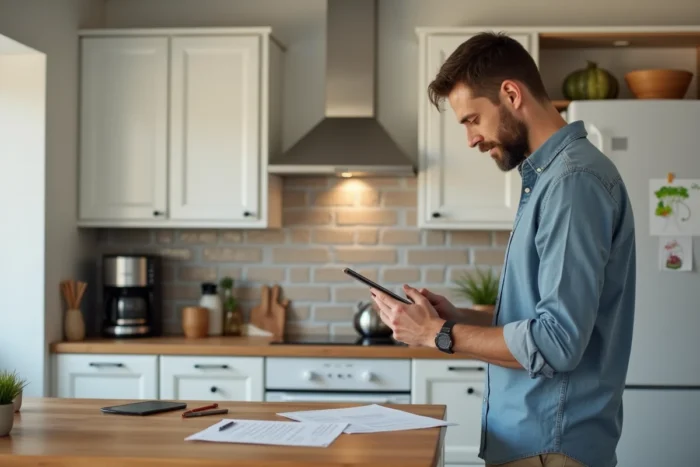
The debate is no longer about “100% office” versus “100% home.” The hybrid model is establishing itself as the dominant configuration in France. Alternating a few days in the office and the rest at home allows for maintaining a connection with the team without enduring the daily commute five days a week.
Why does this model better protect income? Because it maintains the employee’s visibility with their hierarchy. An invisible remote worker risks being forgotten during promotions. In-person days serve this purpose: participating in strategic meetings, maintaining the internal network, reminding others of their contributions.
On the personal life side, the gain is direct. Two or three days without commuting frees up time for activities unrelated to work. This recovered time often represents several hours per week, depending on the home-office distance.
Negotiating a hybrid rhythm with your employer
Approaching the topic through results works better than through personal comfort. Prepare a report of your deliverables over the past months. Show that your productivity does not decrease remotely. Propose a three-month trial period with a midpoint review.
If your company does not have a formalized hybrid policy, rely on the professional interview to raise the question. The reform of this interview, renamed “professional career interview” and scheduled for October 1, 2026, will encourage discussions about job adjustments.
Micro-enterprise regime and employee status: impact on home income
Working from home does not necessarily mean being a remote employee. Many combine a micro-enterprise activity with a main job or start freelancing. The choice of status has a direct impact on what remains at the end of the month.
- The employee status in remote work guarantees a fixed income, comprehensive social coverage, and retirement contributions without additional steps. The trade-off: less flexibility in hours and tasks.
- The micro-enterprise regime offers great freedom but requires managing one’s own accounting, contributions, and downtime. Social charges are proportional to turnover, which can be reassuring at the start.
- The portage salarial constitutes a middle ground: you bill as an independent, but a portage company manages the administrative tasks and pays you a salary. The management cost reduces the margin, but the administrative security is real.
A common pitfall concerns remote workers who switch to micro-enterprise without anticipating the loss of social protection. Compare the overall cost (mutual insurance, provident insurance, supplementary retirement) before leaving a permanent contract for freelance work at home.
Employee caregivers: an overlooked audience in remote work
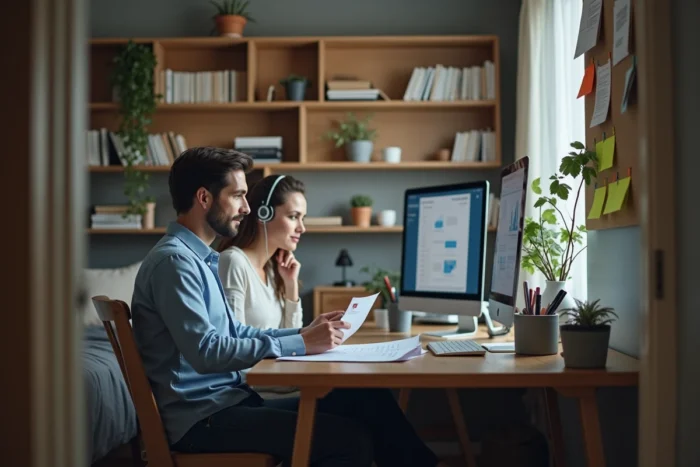
We often talk about parents with young children. Rarely do we mention employees who assist an elderly or disabled relative. According to the 2026 health at work barometer from AG2R LA MONDIALE, many employees juggle professional activity and regular assistance to a relative. A significant portion of their companies already offer adjustments: remote work, staggered hours, dedicated days.
If you are in this situation, working from home represents much more than comfort. It is sometimes the only way to maintain a job without sacrificing the support of a parent or partner. Check with your HR department: the provisions exist, but they are rarely communicated proactively.
Balancing assistance and professional activity
Blocking fixed time slots for assistance and work remains the most effective method. Mixing the two in the same time slot generates frustration on both sides. Separating roles over time protects the quality of work and that of assistance.
Successful remote work relies less on tools than on personal rules maintained over time. Choosing a status suited to one’s financial situation, formalizing disconnection, negotiating a realistic hybrid rhythm: these three decisions cover most of the difficulties faced by remote workers in France.