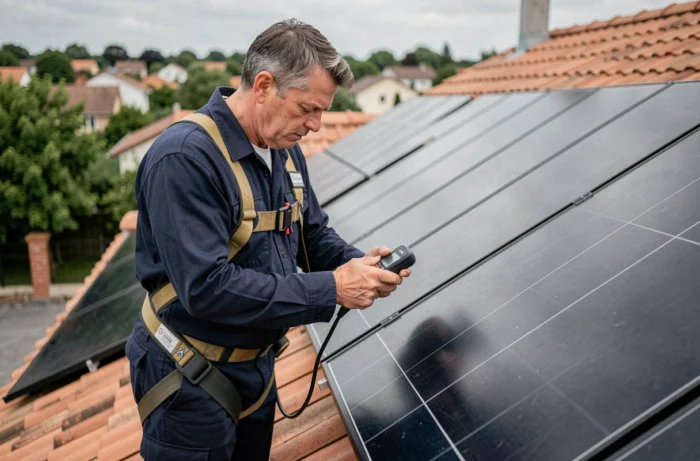
A solar thermal panel captures the sun’s heat to warm a heat transfer fluid, which then feeds a hot water tank or a heating circuit. Its efficiency is the portion of solar energy received that the collector effectively converts into useful heat. This ratio determines the profitability of any solar thermal installation, and it varies much more than one might think depending on the actual usage conditions.
Temperature of the circuit and efficiency of solar thermal collectors
You may have noticed that a lukewarm radiator heats a room more slowly than a hot radiator? The solar thermal collector operates on an opposite principle: the lower the temperature required by the circuit, the higher the efficiency. A solar water heater that heats water to 45 °C makes better use of the captured energy than a central heating system that requires 65 °C or more.
This phenomenon can be explained by the thermal losses of the collector. When the heat transfer fluid circulates at high temperature, the gap with the outside air increases. The collector then dissipates more heat to the environment instead of transferring it to the tank. Understanding the efficiency of a solar thermal panel thus starts with this data: the operating temperature weighs as much, if not more, than the sunlight itself.
Low-temperature applications (domestic hot water, underfloor heating) are where solar thermal performs best. Conversely, supplying high-temperature radiators with conventional flat collectors significantly reduces performance.
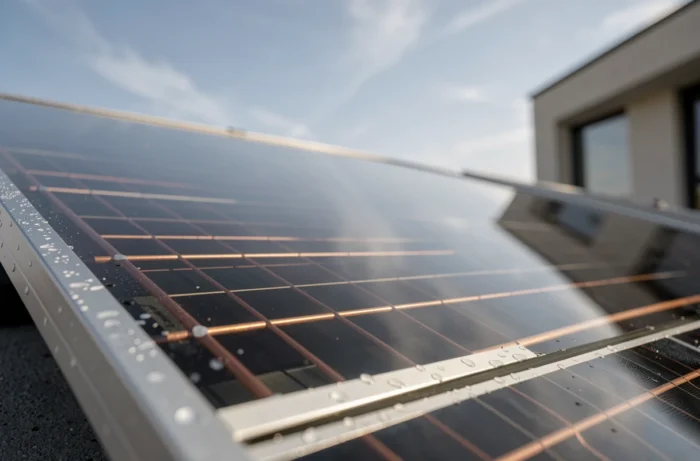
Glazed flat collectors, vacuum tubes: which type for which solar efficiency
Not all solar thermal collectors are created equal. The choice of technology directly determines the range of accessible efficiency.
Glazed flat collectors
This is the most common technology in France for residential use. A dark absorber is placed behind a glass pane that limits losses by convection. Glazed flat collectors offer good efficiency for domestic hot water, as long as the set temperature remains moderate. Their manufacturing is well-controlled, their cost is reasonable, and their lifespan often exceeds twenty years.
Vacuum tube collectors
Here, the absorber is enclosed in a glass tube evacuated of air. The vacuum almost completely eliminates convection losses. The result: vacuum tubes maintain high efficiency even in cold or overcast weather. They are better suited for applications where the required temperature is higher, or in regions with long winters.
Their cost is higher, and their mechanical fragility requires careful installation. For a simple solar water heater in a temperate climate, a glazed flat collector is often sufficient. Vacuum tubes have the advantage when the circuit operates at high temperature or when direct sunlight is limited for a good part of the year.
Solar thermal in low-sunlight regions: an underestimated efficiency
Do you need to live in the south to benefit from solar thermal? Not necessarily. A well-sized installation remains relevant in low-sunlight regions, provided that the collector area and the storage tank volume are adapted.
Diffuse radiation (that of cloudy days) also contributes to heat production, even if the power captured per square meter decreases. A vacuum tube collector, less sensitive to the absence of direct sunlight, can partially compensate for this gap.
A common mistake is to oversize the installation in the hope of compensating for the lack of sunlight. In summer, an oversized system produces an excess of unusable heat, which accelerates the wear of components (overheating of the heat transfer fluid, pressure rise). A sizing adjusted to actual needs protects long-term efficiency.
Market evolution and subsidies: what is changing for solar thermal installations
The French solar thermal market is experiencing a mixed dynamic. Individual residential installations, historically a driving force, have declined in recent years. Individual solar water heaters still represent the majority of installed surfaces, but growth is shifting towards collective and industrial projects.
On the public aid side, the Heat Fund primarily supports large installations. In 2025, more than ten million euros were allocated to solar thermal through this mechanism. However, MaPrimeRénov’ has ceased to fund solar thermal “by gesture” in mainland France since September 2025, which reduces the boost for individuals.
This evolution has concrete consequences on investment choices:
- Co-ownerships and tertiary buildings have easier access to financing through the Heat Fund, improving their return on investment.
- Individuals must factor in the full cost without dedicated aid for solar thermal in their profitability calculations.
- Low-temperature industrial projects (preheating process water, for example) benefit from enhanced support and naturally favorable efficiency.
Three concrete parameters to evaluate the efficiency of your solar thermal installation
Before signing a quote, a few checks can help estimate the actual performance of the proposed system.
- The thermal loss coefficient of the collector (noted a1 and a2 on the technical sheet): the lower these values, the less heat the collector loses. Compare them between manufacturers for the same type of collector.
- The useful area relative to the volume of the tank: an unbalanced ratio (too many collectors for a small tank, or vice versa) degrades annual production. The sizing must correspond to the actual needs of the household.
- The orientation and tilt: a full south exposure with a tilt close to the latitude of the location increases capture. A deviation of a few degrees is tolerable, but an east or west orientation significantly reduces production.
The efficiency of a solar thermal panel is not a fixed number on a product sheet. It results from the interaction between the collector technology, the operating temperature, the local climate, and the quality of the sizing. The most efficient installations are those where each parameter has been calibrated for a specific use, not those that display the highest theoretical efficiency.